
Reviewed · KYOTO BIKE TOURS
See What You Can’t See by Day — Explore Kyoto at Night by E-Bike
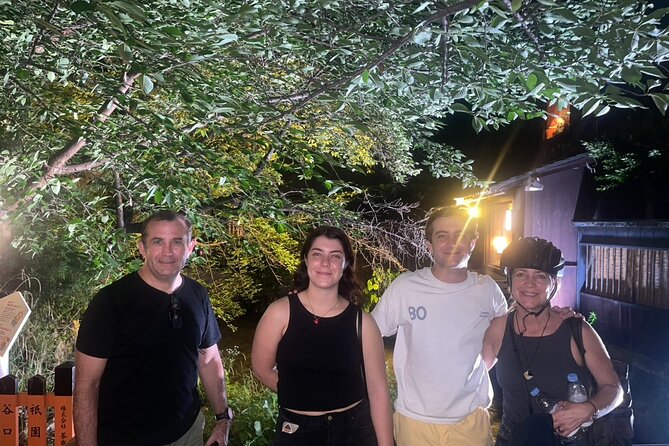
Kyoto after dark trades daytime crowds for lantern glow, quieter streets and the soft rush of water along its canals. On this three-hour e-bike ride, you pedal between temples, old lanes and riverside paths, with time to pause and take photos.
I like two things in particular: the small group of no more than five, which makes it easier to stop when a street catches your eye, and the route’s mix of famous landmarks and local streets. Guide Yuki also gives a safety briefing and clear hand-signal instructions before you set off.
The main consideration is the price: $117.28 per person is a substantial outlay for a three-hour activity, especially since there are no admission tickets included. You’re paying for a guided route, an e-bike and a personal pace, not entry to attractions.
A small-group ride through Kyoto after sunset
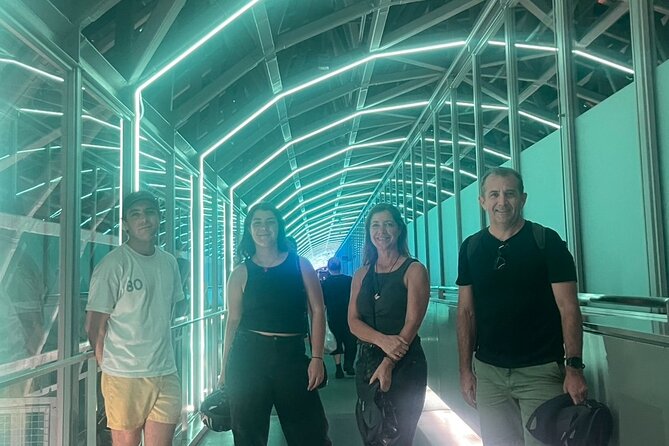
This tour starts near Kyoto Station and loops through several distinct parts of the city. You’ll pass Nishi Hongan-ji, the Shirakawa Canal, the old Nintendo headquarters, the Lake Biwa Canal, Nanzen-ji, Heian Shrine and the Kamo River before returning to the starting point.
The route works best for someone who has already spent time seeing Kyoto by day and wants a different way to read the city. At night, illuminated architecture and quieter roads become part of the experience. You’re not stopping for long temple visits or formal sightseeing talks at every point. Instead, the ride connects places that show different sides of Kyoto, with short pauses for looking around and taking pictures.
The maximum group size is five. That matters here: the appeal is not speed or covering the whole city, but having room to ride at an easy pace and make brief stops. The tour description also presents it as a private experience, so you can ask to pause when something catches your eye.
Getting ready at the Clew cycle port
Meet at a Clew share-cycle port in front of Seikouin Wagatazizou, behind The Thousand Kyoto. The listed meeting address is 570 Higashishiokōjichō, in Shimogyo Ward. Since the precise directions distinguish the cycle port from the hotel entrance, check the meeting instructions before you leave rather than assuming the hotel lobby is the start.
Your guide begins with a briefing on bicycle hand signals and safety. A helmet and bicycle are included, and the e-bike is intended to make the ride manageable without requiring strong cycling fitness. Still, you should be comfortable riding a bicycle and paying attention to traffic and people around you, particularly after dark.
The guide is identified as Yuki, and the included guide service is in Mandarin and Japanese. If you need another language, check that directly before booking; the tour details do not promise interpretation in other languages.
More bike tours in Kyoto:
- Bike Tour Exploring North Kyoto plus Lunch
★ 5.0 · 1,087 reviews - Arashiyama Bamboo Forest & Hidden Gems Bike Tour (Early Bird)
★ 5.0 · 613 reviews - 5 Top Highlights of Kyoto Full Day Bike Tour (E-bike option)
★ 5.0 · 511 reviews
From temple streets to the Shirakawa Canal
The first part of the ride gives you a feel for Kyoto’s older streets and lanes. Rather than treating every road as a direct route to a landmark, the guide can stop when a street or detail catches your eye. That flexibility is one of the advantages of a small, private-format ride: an attractive lane can earn a photo break instead of being passed by.
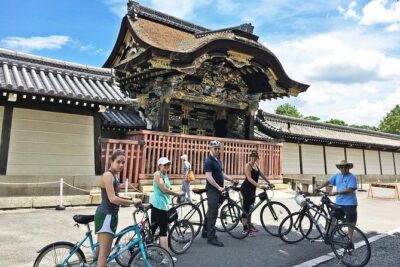
The first named stop is Nishi Hongan-ji, a major temple and the head temple of the Jodo Shinshu Hongwanji-ha sect. Its historic buildings are recognized as a World Heritage site. The stop is listed as about 20 minutes, enough to look at the exterior and absorb the scale of the complex, but not a substitute for a longer temple visit in daylight.
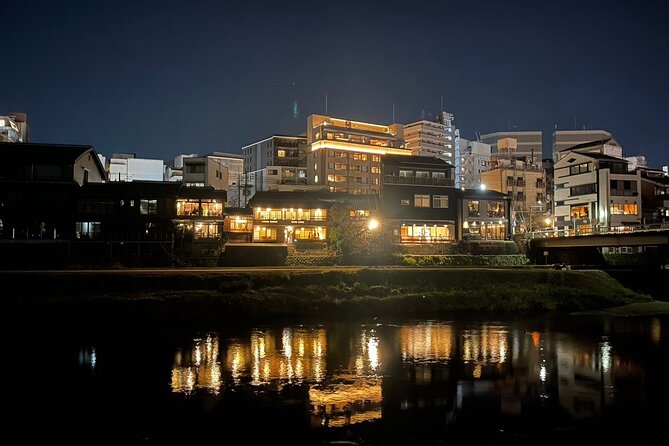
From there, the route reaches the Shirakawa Canal. The area once served as a tea-house district, and older buildings beside the water give this stretch a distinctly Kyoto feel. Seasonal plants, including cherry blossoms, add interest at the right time of year. At night, the canal’s setting is the draw; don’t expect every detail of the buildings or plants to be easy to see in low light.
A local street and Nintendo’s former headquarters
The tour passes along Shomen-dori Street through a local area, where the former headquarters of Nintendo makes an unexpected stop. The building’s scale and appearance contrast with the temples and traditional streets on the route. It’s a reminder that Kyoto’s identity is not limited to historic shrines and wooden houses.
This is a pass-through area rather than a full visit to a museum or company site. The value lies in seeing a piece of the city’s modern cultural history in its actual neighborhood, without turning the ride into a long indoor stop.
Following the Lake Biwa Canal to Nanzen-ji
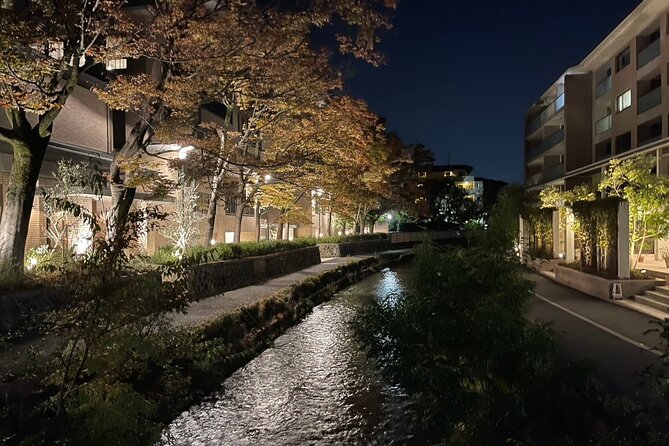
Two scheduled stops bring you to the Lake Biwa Canal around Nanzenji. The canal links Kyoto with Lake Biwa and was designed to manage the change in elevation between the lake and the city. Its waterworks helped supply Kyoto and supported the city’s development.
The canal is particularly suited to an evening ride. You can appreciate it as a working piece of urban infrastructure as well as a waterside route, and the pause gives you time to take in the waterway rather than simply crossing it. Each canal stop is listed at about 20 minutes, so the schedule allows for more than a quick look.
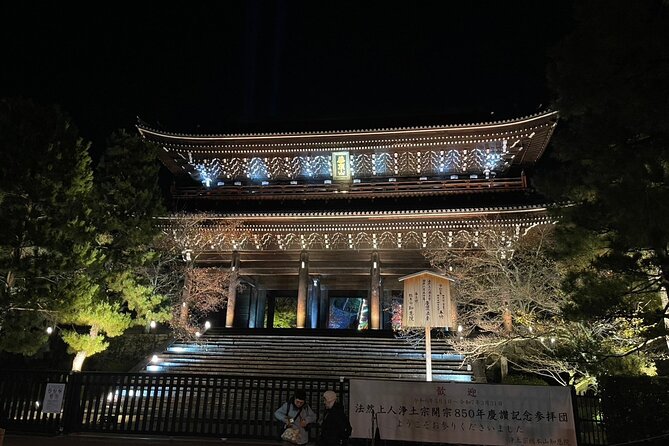
Nanzen-ji follows, with another roughly 20-minute stop. The temple is considered especially important among Kyoto’s Five Mountains, and its main temple buildings and gate give the grounds a sense of scale. The tour description also points to a beautiful garden within the precinct. Because this is an evening ride with a short stop, treat it as an atmospheric introduction, not an in-depth temple tour.
A practical point: the itinerary names several separate locations around the canal and Nanzen-ji area, but the exact sequence and time spent at each may vary with the ride. You’ll be cycling between stops, so the experience is as much about moving through the city as standing at each site.
More night tours in Kyoto:
- Kyoto: Gion Magical Night Walking Tour with Geisha Trivia
★ 4.9 · 2,393 reviews - Night Walk in Gion: Kyoto’s Geisha District
★ 4.5 · 2,003 reviews - Kyoto Night Foodie Tour in Gion (9+ dishes + 6 Sake tastings)
★ 5.0 · 1,762 reviews - Kyoto Gion Night Walk & Geisha District Guided Tour
★ 5.0 · 786 reviews
Heian Shrine’s red torii and the Kamo River finish
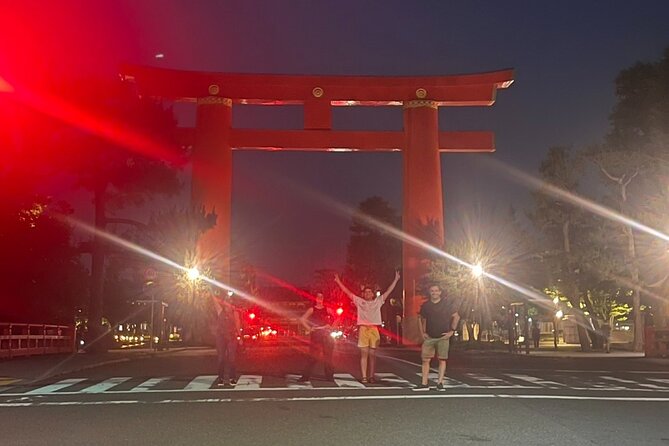
At Heian Shrine, the large red torii gate is the landmark to look for. The shrine was established to mark the 1,100th anniversary of Kyoto becoming the capital, and its enshrined deities include Emperor Kanmu, the 50th emperor of Japan. The scale of the gate makes this a strong visual pause on the route, especially after the more intimate lanes and canals.
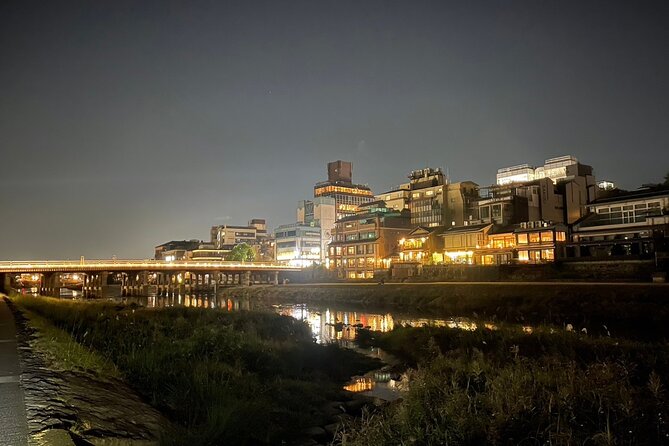
The final major stop is the Kamo River. You can relax by the riverbed or cycle along the bank, then, as described for the tour, put your feet in the water to cool down. This is a simple, informal ending after several historical stops. Bring footwear you can manage easily if you plan to use that option, and remember that conditions at the river can change.
The tour then returns to the original meeting point, where you return the bicycle. The listed ride time is approximately three hours, with short timed stops ranging from 10 to 20 minutes. That leaves a fair portion of the evening for cycling between sites, rather than lingering at any one temple.
What the price includes, and what it does not
At $117.28 per person, this is not a budget way to get from one Kyoto landmark to another. The fee includes a cycling guide, an e-bike and an installed cycling helmet. The listed stops have no admission charge, and the tour does not include temple-entry tickets or other paid attractions.
The value depends on what you want from your evening. If you’d otherwise rent a bicycle and follow a map, the guide and planned route add useful structure, particularly after dark. Yuki’s safety explanations and patient approach are also a practical plus if you’re unsure about using an e-bike or cycling in an unfamiliar city.
The small cap helps make the price easier to justify for people who value personal attention and photo stops. It’s less compelling if your priority is a long visit inside temples, a meal or a low-cost independent ride. Think of it as a guided city circuit, not a full evening of temple admissions.
Who should book this Kyoto night ride
I’d consider this tour if you’re comfortable on a bicycle and want to see several areas of Kyoto without walking between them. The e-bike can make the distance less demanding, and the ride is described as suitable for most participants. Couples, families with eligible children and visitors looking for a shared evening activity may find the format appealing.
Children under 10 can join only if they are taller than 140 centimeters and able to ride a bicycle. They pay the same price as adults. If you’re bringing a child, be realistic about their comfort with cycling and the length of a three-hour outing.
You should also be happy with an outdoor activity after dark. This is not a good fit if you want to spend substantial time inside temples or need a leisurely walking pace with frequent indoor breaks. Weather matters, too: the tour requires good weather, and poor conditions can lead to a different date or a full refund.
Booking advice and final call
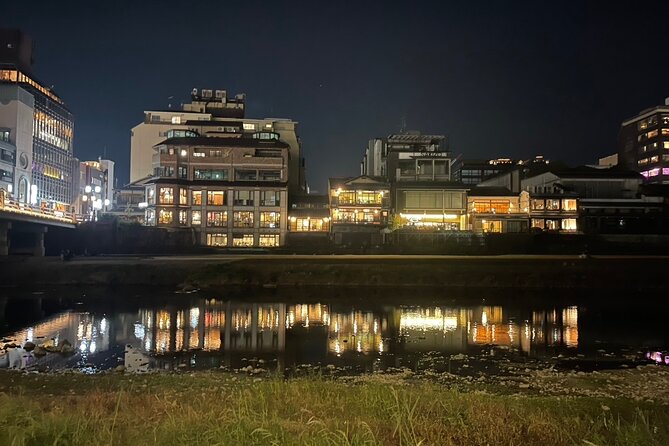
Book this ride for the route and the experience of moving through Kyoto after sunset, not simply for the number of famous sights. You’ll get a useful range of places, from Nishi Hongan-ji and Nanzen-ji to a canal, a former Nintendo headquarters and the Kamo River, but the stops are brief.
I’d choose it if you enjoy cycling, value a small group and want a guide to connect the landmarks with local streets. I’d skip it if the price would feel steep for a three-hour ride, or if you’d rather explore temples at your own pace. For a first visit, it can make a memorable introduction to Kyoto at night; for a return visit, it offers a pleasant change from the usual daytime circuit.
Key points
- The group is capped at five, with a private-tour format that allows for photo pauses.
- Yuki leads the ride, with a safety briefing and hand-signal instructions before departure.
- The route combines landmarks and local details, from Nishi Hongan-ji and Nanzen-ji to Nintendo’s former headquarters.
- The Lake Biwa Canal and Kamo River give the ride a waterside thread, with a chance to cool your feet at the end.
- The e-bike, helmet and guide are included, but temple admission tickets are not.
- Children under 10 must be over 140 centimeters tall and able to ride, and they pay the adult price.
FAQ
How long is the Kyoto night e-bike tour?
The tour lasts approximately three hours, including the cycling and scheduled stops.
Where does the tour start and end?
It starts and ends at 570 Higashishiokōjichō in Shimogyo Ward, near The Thousand Kyoto. The guide meets you at a Clew share-cycle port in front of Seikouin Wagatazizou, behind the hotel.
What is included in the price?
The price includes a cycling guide, use of a bicycle and an installed cycling helmet. Admission tickets are not listed as included.
What language does the guide speak?
The included guide service is in Mandarin and Japanese.
How many people can join?
The tour has a maximum of five participants.
Can children join the ride?
Children under 10 can participate if they are taller than 140 centimeters and can ride a bicycle. They pay the same fee as an adult.
Is the tour suitable for most fitness levels?
The activity information says most participants can take part, and the e-bike is intended to make cycling easier. Participants still need to be able to ride a bicycle.
What happens if the weather is poor?
The tour requires good weather. If poor weather causes a cancellation, you’ll be offered another date or a full refund.
Newly added in Kyoto
- Uji: Private immersion into Kyoto’s tea and reglious culture★ 5.0 · 17 reviews
- Whisk Your Own Matcha: A Zen Matcha Experience at Temple★ 3.6 · 7 reviews
- Kyoto tea town for matcha lovers★ 5.0 · 16 reviews
- Treasures of Kyoto: Gion & historical Walking Tour★ 5.0 · 6 reviews
- Kyoto Matcha Green Tea Tour★ 4.5 · 23 reviews
- Uji and Wazuka Matcha Farm Half Day Private Guided Tour★ 5.0 · 21 reviews
- Uji Tea Ceremony and UNESCO Heritage Walking Tour★ 5.0 · 20 reviews
- Utilising upcycled Matcha! Creating matcha incense (Uji, Kyoto)★ 5.0 · 6 reviews
Kyoto Bike Tours, compared.
Arashiyama Bamboo Forest & Hidden Gems Bike Tour (Early Bird)
Read our review →
5 Top Highlights of Kyoto Full Day Bike Tour (E-bike option)
Read our review →
South Kyoto in a Nutshell: Gentle Backstreet Bike Tour!
Read our review →
Hidden Gems E-Bike Tour with Local Japanese Guide
Read our review →
Pedal Adventure Kyoto’s iconic landmarks on an e-bike tour
Read our review →Browse the lists this tour appears in