
Reviewed · KYOTO WALKING TOURS
Kyoto Early Riser Platinum One-Day Walking Tour
Kyoto’s great challenge is how to fit its far-flung sights into one day. This private, early-start tour links the red gates of Fushimi Inari, Arashiyama’s bamboo, Kinkakuji’s gold pavilion, and the food stalls of Nishiki Market, with a guide to help you make sense of the city between stops.
I like two things in particular: you can set the pace and focus with your own group, and the guide can add context or help you find a good lunch spot rather than simply shepherding you from one landmark to the next. A guide may also help with photos and point out scenic corners along the way.
The trade-off is the distance. These sights sit in different parts of Kyoto, and buses and trains take time. You will also pay for public transport and admission separately, so this works best if you want a full day of highlights and are comfortable walking and moving around the city.
- Start early at Fushimi Inari: Give the famous vermilion torii gates an hour before the day gets away from you.
- Cross the city for the bamboo grove: The Arashiyama stop lasts about 70 minutes, but transport adds to the day.
- See Kinkakuji’s Golden Pavilion: The temple visit is brief, and admission is not included.
- Add context around Kitano: A shrine and nearby geisha district offer a quieter change of pace from the headline sights.
- Finish with Kyoto flavors: Nishiki Market gives you time to browse its long shopping street and sample local foods.
- Budget for extras: The tour costs $130.79 per person; listed admission and transport costs are ¥500 and ¥1,700 per person.
A full Kyoto day, planned around your group
This is an eight-hour private tour for first-time visitors who want a broad introduction to Kyoto’s cultural sights. The group is just yours, so you can ask questions freely and tell the guide what interests you. That private format is especially useful when your group wants to linger for photos, move at a gentler pace, or hear more about a particular stop.
The early start is practical, not just a selling point. Fushimi Inari and the bamboo grove are popular, and getting going early gives you a better chance to see them before the day fills up. It also lets you cover more ground before the heat builds. The exact start time is not specified, so check that detail when arranging your day.
The route is ambitious. Fushimi Inari is in southern Kyoto, Arashiyama is to the west, and the other stops take you north and back toward central Kyoto. The visit times add up to about four hours and 35 minutes, leaving the rest of the eight-hour day for transport, transitions, and a meal. Those connections are part of the experience, but they also mean you should not expect eight hours of sightseeing on foot.
Fushimi Inari’s red gates set the tone
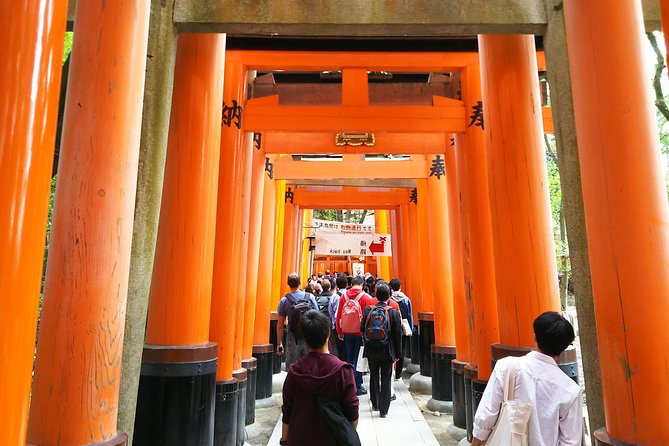
The first stop is Fushimi Inari-taisha, known for its long corridors of vermilion torii gates. Worshippers donate the gates in gratitude for good fortune, so the rows are not just striking scenery; they are part of an active religious site. You have about an hour here, with no admission charge listed.
The scale is the pleasure. As you pass through the gates, the repeating color and close-set posts create a strong sense of movement. An hour is enough to see the famous approach and take photos, though it is not a long visit if you want to explore extensively. Let your guide know if you have a particular interest in the shrine or want to make the most of the time.
Starting here also makes sense for crowd management. The early hour is one of the tour’s best practical features, especially at a place where the most photographed stretches can feel busy later in the day.
More walking tours in Kyoto:
- Kyoto Geisha Walking Tour: Gion District & Hidden Gems
★ 4.7 · 3,273 reviews - Kyoto: Gion Magical Night Walking Tour with Geisha Trivia
★ 4.9 · 2,393 reviews - Kyoto: Gion Geisha District Walking Tour – Stories of Geisha
★ 4.7 · 2,187 reviews
Arashiyama’s bamboo street is a short, scenic pause
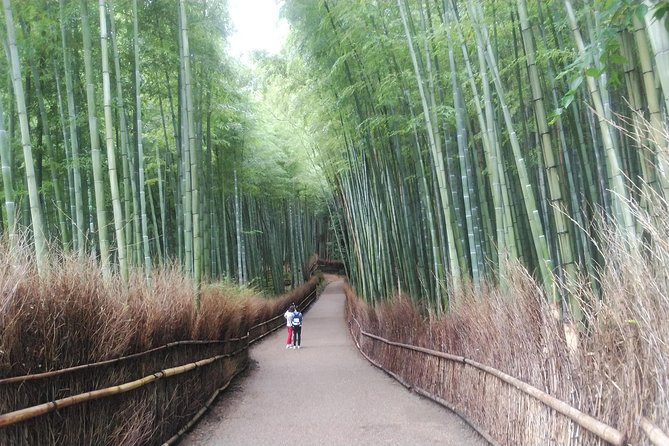
Next comes Bamboo Forest Street, with about 70 minutes scheduled. The bamboo’s muted green, the light filtering through the stalks, and the sound of leaves and trunks shifting in the breeze are the appeal. It is a very different mood from Fushimi Inari’s bright red gates.
This is a scenic stop rather than a long, guided activity. The time may feel short if you hoped to spend much longer in the bamboo area, so keep that in mind when comparing this tour with a slower, two-day plan. The day’s broad route is designed to show you several parts of Kyoto, not to linger for hours in one neighborhood.
The journey here is another reminder that Kyoto’s famous sights are spread out. One past participant found the public transport connections tedious and felt that getting between stops cut into sightseeing time. That is a fair concern: Kyoto’s buses and trains are useful, but a day that crosses the city several times will involve real transit time.
Kinkakuji offers the day’s golden landmark
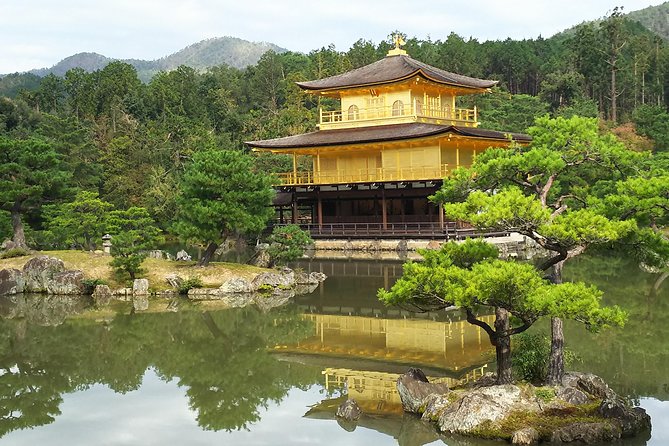
Kinkakuji, the Golden Pavilion, gets about 50 minutes. The gilded building is the main event, and it is easy to see why it has become one of Kyoto’s signature sights. The temple is popular, so expect other people around the view. The tour’s early start helps with the day overall, but it does not mean every stop will be quiet.
Admission is not included. The tour information lists an extra admission fee of ¥500 per person, and public transport at ¥1,700 per person. Treat these as costs on top of the tour price, and confirm the current fees when you book.
I would approach Kinkakuji as a focused visit: take in the pavilion, enjoy the setting, and use the guide’s explanation to understand why it matters beyond its photogenic surface. The stop is relatively short, which suits a one-day overview but may feel hurried if you prefer a slower temple visit.
Kitano Tenmangu adds a local purpose
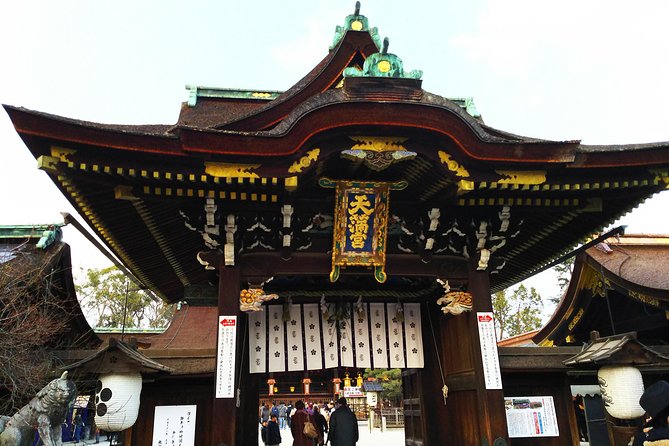
The route then turns to Kitano Tenmangu, a shrine founded in 945 and dedicated to Sugawara no Michizane, associated with learning and academic success. Students visit to pray for good exam results, which gives the site a clear connection to everyday hopes as well as religious tradition.
You have around 30 minutes here, and no admission fee is listed. Compared with the Golden Pavilion, Kitano offers a chance to see a place with a specific purpose for worshippers, rather than only a famous view. If you are interested in Japanese culture, this context can make a short stop feel more meaningful.
The limited time does mean you will need to keep moving. If you have a particular interest in shrine customs, ask your guide to explain what you are seeing as you go.
More Kyoto tours in Kyoto:
- PERFECT KYOTO 1-Day Bus Tour
★ 5.0 · 13,518 reviews - Kyoto: Fushimi Inari, Kinkakuji, Bamboo Grove 1 Day Bus Tour
★ 4.8 · 4,316 reviews - Kyoto: Tea Ceremony in a Traditional Tea House in Kiyomizu
★ 4.9 · 3,519 reviews - Kyoto: Tea Ceremony Ju-An at Jotokuji Temple
★ 4.9 · 3,207 reviews
Kamishichiken brings Kyoto’s geisha district into view
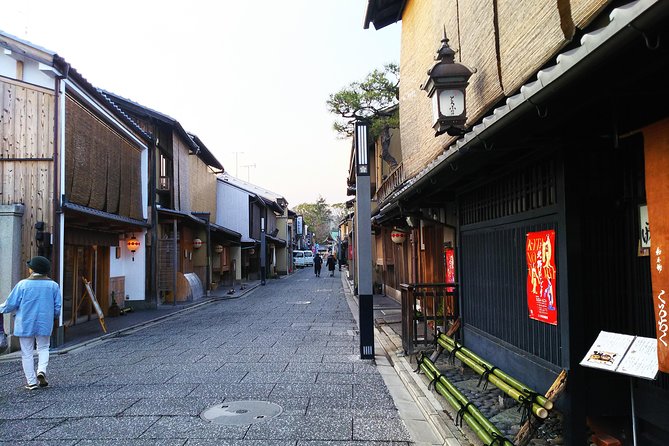
Close to Kitano Tenmangu is Kamishichiken, one of Kyoto’s five hanamachi, or geisha districts. The tour allows about 25 minutes to walk through the area. It has fewer geisha houses and geiko and maiko than some of the city’s other districts, which can make it a useful glimpse of a traditional neighborhood without turning the stop into a long detour.
This is a brief look, not a performance or a guaranteed encounter with geiko or maiko. Its value is in seeing the district itself and understanding its place beside the shrine. Keep expectations grounded: the itinerary promises time in the neighborhood, not a staged cultural event.
Nishiki Market ends the day with food and browsing
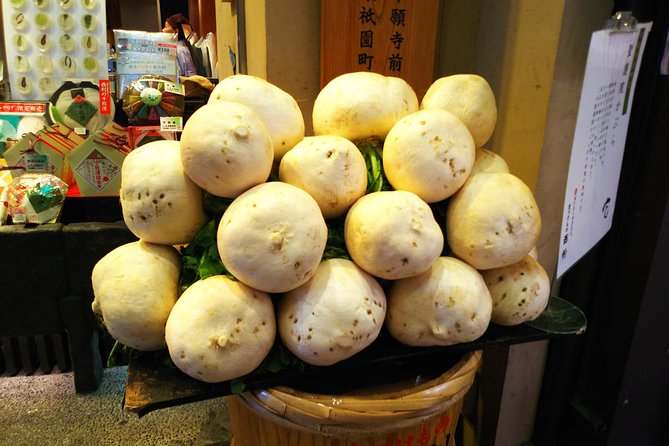
The final listed stop is Nishiki Market, where you have about 40 minutes. The covered shopping street stretches roughly 390 meters and has 126 shops, with a history of serving Kyoto residents for about 400 years. You can look for local vegetables and pickles, and some foods are available to taste.
Forty minutes is enough for a quick browse and a few tastes, but it is not a leisurely food tour. If market food is a priority, tell your guide early and ask how best to use the time. The tour price does not include a meal. A guide may be able to suggest a lunch place, and guides have helped groups choose a meal that suited them, but you should not assume food is included.
Ending here gives you a lively, practical counterpoint to temples and shrines. It is also a good place to ask about ingredients or local specialties before choosing what to try.
The guide is the difference between a route and a day out
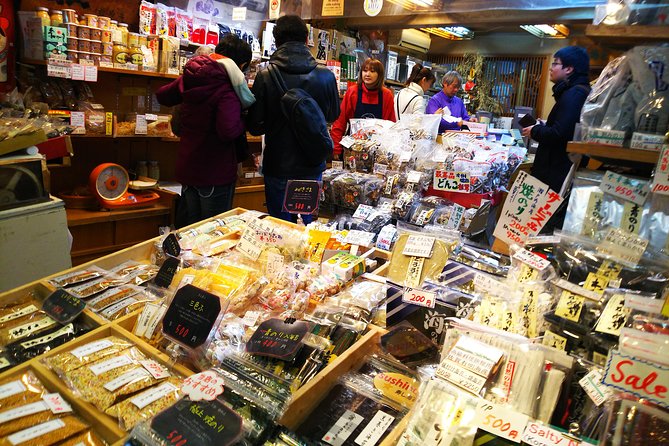
The professional guide is the only included service beyond the tour itself, and that is where much of the value rests. Because the tour is private, the guide can respond to your questions and interests. Guides associated with the experience include Gigi, Fuji-san, Seiya, and Meg, though you should not count on a specific person unless the provider confirms your assignment.
The strongest guide experiences have involved clear explanations, scenic photo suggestions, and small adjustments to suit the group. Gigi, for example, has been associated with adapting the day to a group’s interests and helping with photos; Meg has been known to bring hand warmers on a cold morning. Those details show the kind of personal attention a private tour can provide, but they are not guaranteed services.
The guide may also help make public transport less daunting. One group particularly liked using buses and the subway because it brought them through Kyoto neighborhoods. Another found the connections slow and tedious. Both reactions make sense: public transit can show you more of the city, but it takes patience, and you may spend a meaningful part of the day in transit.
What the $130.79 price does and does not cover
At $130.79 per person, the main benefit is a private guide for a full day and a route that connects six major stops. You are paying for guidance and a plan, not a package that covers every expense. Admission and public transport are extra, listed at ¥500 and ¥1,700 per person, and lunch is not included.
For a first visit, that can be good value if you want help navigating and interpreting the sights. A private guide can save you from piecing together a route yourself and can adjust the day to your interests. Group discounts are available, which may improve the per-person value if you are booking with others.
The price is less compelling if you want to spend most of the day at one or two places, or if you are happy to plan your own route. In that case, splitting the sights across two days would give you more room to explore each area and reduce the feeling of rushing between distant stops.
Who should book this Kyoto walking tour
I would choose this tour if it is your first time in Kyoto, you have one full day available, and you want an informed overview rather than a deep visit to a single temple district. It is also a good fit for a private group that values flexibility and wants a guide to help with cultural context, transit, photos, and a meal suggestion.
Think twice if you dislike long days with several transport connections, need lots of time at each sight, or would rather explore at your own pace. The tour involves quite a bit of walking and is not stroller accessible. It is listed as accessible for people with limited mobility and limited eyesight, but that should not be taken as a guarantee that the full route will suit every need. Ask the provider about your specific requirements before booking.
The tour is recommended by 92 percent of 24 ratings and has a 4.7 overall score. That is encouraging, but the practical question is whether the pace matches your style. If you want six highlights in one day and accept the extra costs and transit, book it. If you want Kyoto at a slower pace, divide the route over two days.
FAQ
How long is the Kyoto Early Riser Platinum One-Day Walking Tour?
The tour lasts about eight hours. The listed time at the six stops totals roughly four hours and 35 minutes, with the rest of the day allowing for transport and transitions.
Is this a private tour?
Yes. Only your group participates, and a professional guide is included.
Where does the tour start and end?
It starts at Kyoto Station Building, at 901 Higashishiokōjichō in Kyoto’s Shimogyo Ward. It ends back at the same meeting point.
Are admission tickets and public transport included?
No. Public transport is listed at ¥1,700 per person, and an admission fee of ¥500 per person is also listed as extra.
What sights are included?
The stops are Fushimi Inari-taisha Shrine, Bamboo Forest Street, Kinkakuji Temple, Kitano Tenmangu Shrine, Kamishichiken Kaburenjo Theatre, and Nishiki Market.
Is lunch included?
No meal is listed as included. A guide may help you find a lunch place, but you should budget separately for food.
Is the tour suitable for people with limited mobility?
The experience is listed as accessible for people with limited mobility, but it also involves quite a bit of walking. It is not stroller accessible, so ask the provider about your specific needs before booking.
Can I cancel for a refund?
You can cancel at least 24 hours before the experience’s start time for a full refund. Cancellations or changes made less than 24 hours before the start time are not accepted, and poor weather may lead to a different date or a full refund.
Newly added in Kyoto
- Uji: Private immersion into Kyoto’s tea and reglious culture★ 5.0 · 17 reviews
- Whisk Your Own Matcha: A Zen Matcha Experience at Temple★ 3.6 · 7 reviews
- Kyoto tea town for matcha lovers★ 5.0 · 16 reviews
- Treasures of Kyoto: Gion & historical Walking Tour★ 5.0 · 6 reviews
- Kyoto Matcha Green Tea Tour★ 4.5 · 23 reviews
- Uji and Wazuka Matcha Farm Half Day Private Guided Tour★ 5.0 · 21 reviews
- Uji Tea Ceremony and UNESCO Heritage Walking Tour★ 5.0 · 20 reviews
- Utilising upcycled Matcha! Creating matcha incense (Uji, Kyoto)★ 5.0 · 6 reviews
Kyoto Walking Tours, compared.
Kyoto Geisha Walking Tour: Gion District & Hidden Gems
Read our review →
Gion Magical Night Walking Tour with Geisha Trivia
Read our review →
Gion Geisha District Walking Tour – Stories of Geisha
Read our review →
Nishiki Market Brunch Walking Tour (7 Tastings + Brunch)
Read our review →
Kyoto Arashiyama Walking Tour: Bamboo, Monkeys, Gardens & Secrets
Read our review →
Nara Half Day Trip Walking Tour (Private Option Available)
Read our review →Browse the lists this tour appears in