
Reviewed · FUSHIMI INARI TOURS
Kyoto Magical Night English Tour: Gion & Fushimi Inari Shrine
Fushimi Inari after dark is a different sort of Kyoto sight: rows of red torii gates climb into shadow beneath the trees, while the city’s famed old streets feel quieter under evening lights. This private English-language walk links the shrine with Gion and several Higashiyama landmarks in about two and a half hours.
I like two things in particular: a guide who explains what you’re seeing, from shrine etiquette to local stories, and a route that combines famous sights with smaller lanes. Guides such as Ikki and Yui have also been praised for taking thoughtful photos and offering useful Kyoto advice.
The trade-off is the pace and distance. You will cover a lot on foot, use public transport, and have only brief stops at several sites. Wear comfortable shoes, arrive on time, and don’t expect a long, unhurried visit at every temple or shrine.
At a glance
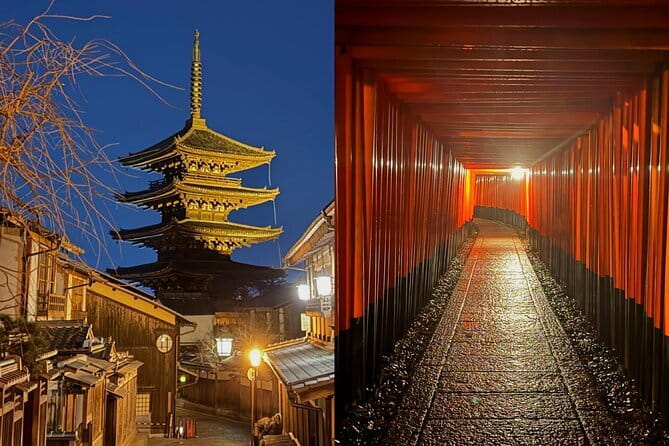
- Fushimi Inari after dark: Spend about an hour among the shrine’s famous torii gates, with time for context and photos.
- A broad Higashiyama route: Visit Gion, Hanamikoji Street, Yasui-Konpiragu, Yasaka Pagoda, Sannenzaka and Ninenzaka, Nene-no-Michi, and Yasaka Shrine.
- A private experience: Only your group participates, so your guide can speak directly with you and answer questions.
- Photos are part of the experience: Your guide takes photos during the walk. Some guides have sent them soon after the tour, though no delivery time is specified.
- Budget for transport: The tour costs $26.43 per person, while public transport costs an additional ¥480 per person. Food and drinks are not included.
- Bring walking shoes: The tour is designed for people with moderate fitness and includes plenty of time on foot.
Fushimi Inari’s torii gates after dark
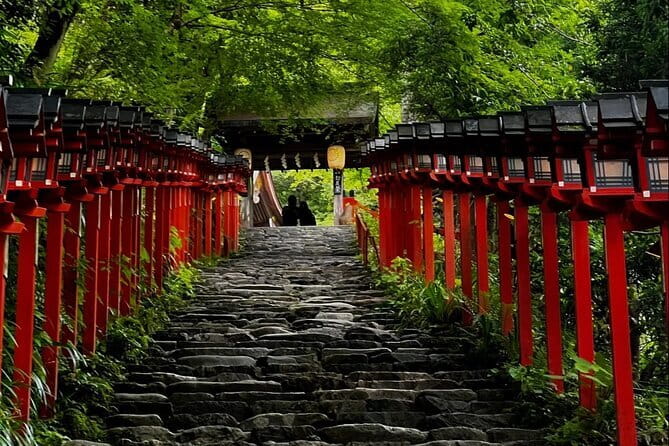
The evening begins at the Statue of Izumo-no-Okuni in Kyoto’s Higashiyama Ward. From there, the tour goes to Fushimi Inari-taisha, one of Kyoto’s best-known Shinto shrines. Its defining feature is the long succession of red torii gates that create corridors up the forested slopes of Mount Inari.
Plan for about an hour here. That gives you time to walk through part of the shrine grounds, take in the gates, and hear how the site is connected with Inari, the deity associated with rice and prosperity. A guide can also help explain how to behave at a Shinto shrine, which makes the visit more meaningful than simply following the path and snapping a picture.
Night changes the mood. The gates and wooded paths feel different without the bright daytime scene, and you may find fewer people around. But this is still a popular place, so quiet stretches are not guaranteed. The attraction is not just the photo opportunity: it is also a chance to learn what the shrine means and how people use it.
You will not have unlimited time to explore every path on the mountain. The stop lasts about an hour, and the rest of the route has several more sights to cover. If you want to hike far up Mount Inari or spend a long time at the shrine, this short tour is not a substitute for a separate visit.
More Fushimi Inari tours in Kyoto:
- Kyoto: Fushimi Inari, Kinkakuji, Bamboo Grove 1 Day Bus Tour
★ 4.8 · 4,316 reviews - Fushimi Inari Hidden Hiking Tour (Private Option Available)
★ 5.0 · 1,750 reviews - Kyoto/Osaka: Nara, Fushimi Inari Taisha, Arashiyama Bus Tour
★ 4.7 · 1,275 reviews
Gion’s lanes, teahouses, and old houses
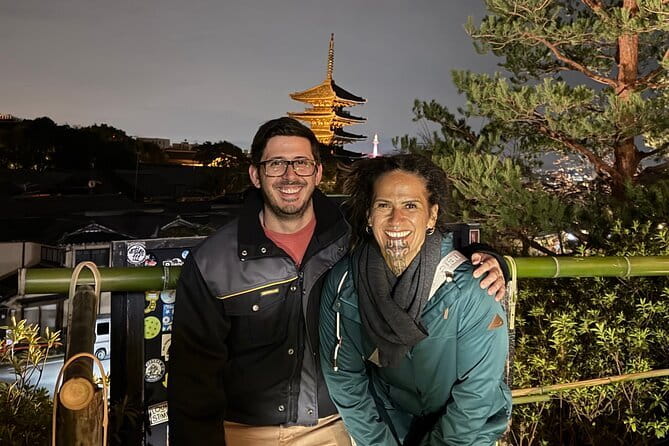
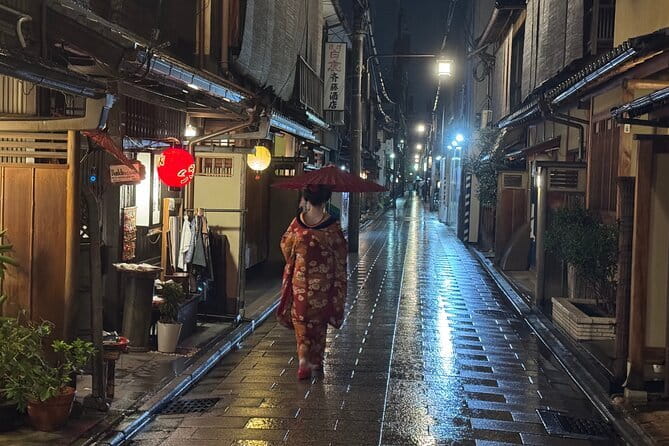
After Fushimi Inari, the route turns to Gion, Kyoto’s best-known geisha district. Hanamikoji Street is a short stop of about 10 minutes. Its traditional wooden machiya houses and teahouses give you a concentrated look at the area’s historic character, but the limited time means you are there for an introduction, not a full neighborhood wander.
You might see a geisha or maiko, but don’t plan your evening around it. The street’s appeal does not depend on an encounter. A guide can explain the setting and local customs while helping you notice details you might otherwise pass without understanding.
The broader Gion stop also lasts about 10 minutes. That may sound brief, but the route continues through several nearby sights, and your guide can help connect the district’s architecture and atmosphere with the rest of Kyoto. If you would like to linger over dinner or explore the lanes at your own pace, consider returning another evening.
A key advantage of having a local guide is the chance to ask questions as you walk. Past guests have appreciated guides such as Ikki, Yuki, and Yui for explaining history and culture in an approachable way. The guide’s style will vary, but this tour is designed around conversation rather than a recorded commentary.
Yasui-Konpiragu and its relationship stone
Yasui-Konpiragu is a small shrine with a distinctive purpose: people visit to pray for an end to harmful relationships and for new, positive ties. The stop is about 10 minutes, so your guide can introduce the shrine’s meaning and point out the practice associated with its relationship stone.
This is a good example of why a guide adds value here. Without context, the shrine may look like a quick stop on a busy walk. With an explanation, its role becomes clearer, and you can decide whether you want to take part in its ritual. One guide has also been praised for showing guests how to make offerings and pay their respects at shrines.
Bring a few coins if you would like to make a wish or offer a prayer. That is a useful small preparation, especially since you will not be stopping for food or drinks along the way.
Yasaka Pagoda and the sloping lanes
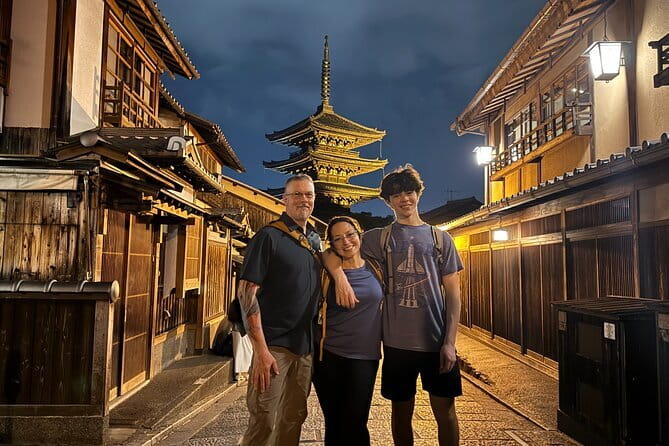
The route next reaches Yasaka Pagoda, also called Hokanji Temple. The pagoda is one of Kyoto’s most recognizable sights, and its scale is striking among the surrounding streets. The stop lasts about 15 minutes, which gives you time to look, take photographs, and hear a little about the structure.
The description of the pagoda as built without nails is part of its appeal, but the visit itself is short. You will not have time for a detailed architectural study. Think of this as a well-placed pause and a chance to see one of the city’s familiar landmarks in the evening.
Sannenzaka and Ninenzaka follow, with about 15 minutes set aside for these traditional stone-paved paths. Historic wooden buildings, shops, and restaurants line the lanes. At night, the streets can feel more atmospheric and less crowded than during the day, though opening hours and the number of people around can vary.
Watch your footing on the sloping stone paths. One guide takes care to explain why visitors are advised to walk carefully here, and the practical point is simple: focus on the ground as well as the view. The short stop does not allow much time for browsing shops or sitting down, so save that for a return visit if you want to explore at leisure.
More Gion tours in Kyoto:
- Kyoto Geisha Walking Tour: Gion District & Hidden Gems
★ 4.7 · 3,273 reviews - Kyoto: Gion Magical Night Walking Tour with Geisha Trivia
★ 4.9 · 2,393 reviews - Kyoto: Gion Geisha District Walking Tour – Stories of Geisha
★ 4.7 · 2,187 reviews - Best of Kyoto: Gion, Geisha, Pagodas & Cobblestones
★ 4.9 · 2,058 reviews
Nene-no-Michi and Yasaka Shrine
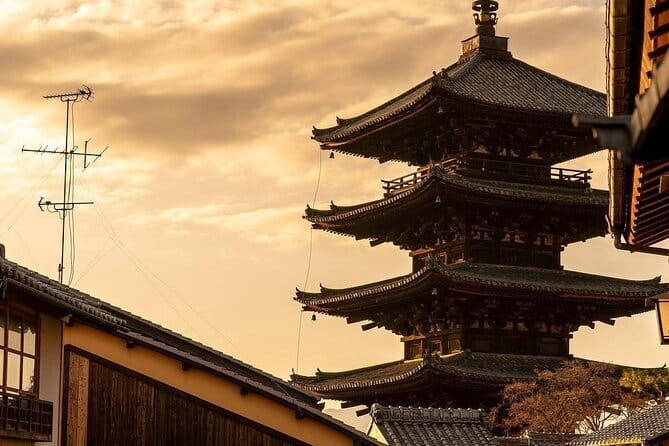
Nene-no-Michi is a quieter path named for Nene, the wife of a powerful shogun. The tour allows about 15 minutes here, taking you past historic temples and offering a change of pace from the busier streets. This part of the walk helps link the landmarks into a neighborhood rather than a string of separate photo stops.
The final destination is Yasaka Shrine, where the tour spends about 15 minutes. The shrine is described as the headquarters of 2,300 related shrines across Japan and is associated with prosperity and protection. It is a fitting final stop: after seeing several different kinds of religious sites, you can ask your guide to clarify what distinguishes a Shinto shrine from a Buddhist temple.
The stops are short, but they add up to a useful evening overview. You see the landmarks, learn some context, and get a route through Higashiyama that can help you decide where to return. One family with children found that their guide, Ikki, made the customs engaging and took photos at each stop. That personal attention is one of the strongest reasons to choose a private walk over a self-guided route.
What the pace and private format mean
The advertised duration is about two hours and 30 minutes. The listed stops total roughly two hours, leaving the remaining time for moving between locations and using public transport. The tour is a walking experience, not a vehicle-based sightseeing circuit, so expect stretches of walking between short visits.
The private format means only your own group joins. That can make it easier to ask questions, take breaks, or focus on subjects that interest you, although the tour still has a set duration and a wide route to cover. One guide has been praised for being patient with older people who needed frequent breaks. Another helped a family with four children aged 5 to 12 stay engaged. Those examples suggest the format can work for different ages, but they do not guarantee a particular pace or level of customization.
Some guides walk briskly to cover the ground, so tell your guide early if you need a slower pace or extra pauses. The tour calls for moderate physical fitness. Comfortable shoes matter more than dressing for a formal temple visit, especially on the stone paths.
Is $26.43 a fair price?

At $26.43 per person, the price is appealing for a private, English-language tour that covers several major Kyoto sights and includes a local guide. Admission fees for the temples and shrines are included, as are photos taken during the tour. That gives you more than transport between landmarks: you get explanations, help with shrine customs, and a local perspective on the streets.
The price does not cover public transport, which costs ¥480 per person, or food and drinks. There are group discounts, but no discount details are provided. The value is strongest if you want an informed introduction to Kyoto in one evening, especially at the start of your stay when local advice can help you plan the next few days.
It is less suitable if your priority is a slow visit, shopping time, or a long climb at Fushimi Inari. The schedule covers a lot of ground with brief stops. You are paying for a guided overview and a carefully linked route, not a deep visit to each location.
The tour has a 5 out of 5 rating from 97 reviews, and 100% recommend it. The aspects most often praised are the guides’ warmth, cultural explanations, route knowledge, personal attention, and photos. Ikki is named often, while Yui, Yuki, Mariko, and Joi are also mentioned. You cannot assume you will get a specific guide unless the operator confirms it, but the accounts point to a strong emphasis on personal guiding.
Practical details before you book
The meeting point is the Statue of Izumo-no-Okuni, Kawabatacho, Higashiyama Ward, Kyoto. The activity ends back at the meeting point. Confirm your route to the statue before leaving, and arrive on time: late arrivals cannot join the tour or receive a refund.
Confirmation is provided at booking, and the meeting point is near public transport. The tour is designed for people with moderate fitness and plenty of walking. Free cancellation is available until 24 hours before the start time; cancellations or changes made less than 24 hours before are not accepted for a refund or adjustment.
Should you book this Kyoto night walk?
Book it if you want a compact, guided introduction to Fushimi Inari, Gion, and Higashiyama, and value explanations and photos as much as the sights themselves. The private format and local guide can make a busy first evening in Kyoto feel easier to navigate, while the evening setting gives familiar streets a different mood.
Skip it if you want to spend hours at one shrine, browse shops at length, or set your own pace throughout. For the right person, this is an efficient way to see several memorable places and learn how they fit into Kyoto’s religious and cultural life. Wear good shoes, bring a few coins, and keep enough energy for the walk.
FAQ
How long is the tour?
It lasts approximately two hours and 30 minutes.
Where does the tour start and end?
It starts at the Statue of Izumo-no-Okuni in Kawabatacho, Higashiyama Ward, Kyoto, and ends back at the meeting point.
Is the tour private?
Yes. Only your group participates.
What is included in the price?
The local English-speaking guide, admission fees for all temples and shrines, and photos taken during the tour are included.
What extra costs should I expect?
Public transportation costs ¥480 per person. Food and drinks are not included.
How much walking is involved?
The experience is designed as a walking tour, with public transport used along the way and plenty of time on foot. A moderate fitness level is recommended.
Can I cancel for a refund?
Yes, if you cancel at least 24 hours before the start time. Cancellations made less than 24 hours in advance are not refundable.
More temple and shrine tours in Kyoto
- Kyoto: Tea Ceremony Ju-An at Jotokuji Temple
★ 4.9 · 3,207 reviews - World Heritage Kyoto & Nara Uji Authentic Matcha Experience
★ 5.0 · 1,573 reviews - Arashiyama Bamboo, Temple, Monkeys, or Secret Sake Brewery
★ 4.8 · 886 reviews - Kyoto: Arashiyama Bamboo Forest, Monkeys, Matcha & Temple Tour
★ 5.0 · 759 reviews
More night tours in Kyoto
- Night Walk in Gion: Kyoto’s Geisha District
★ 4.5 · 2,003 reviews - Kyoto Night Foodie Tour in Gion (9+ dishes + 6 Sake tastings)
★ 5.0 · 1,762 reviews - Kyoto Gion Night Walk & Geisha District Guided Tour
★ 5.0 · 786 reviews - Kyoto Ghost Tour: Dark Tales, Urban Legends, Bamboo Forest Night
★ 5.0 · 625 reviews
Newly added in Kyoto
- Uji: Private immersion into Kyoto’s tea and reglious culture★ 5.0 · 17 reviews
- Whisk Your Own Matcha: A Zen Matcha Experience at Temple★ 3.6 · 7 reviews
- Kyoto tea town for matcha lovers★ 5.0 · 16 reviews
- Treasures of Kyoto: Gion & historical Walking Tour★ 5.0 · 6 reviews
- Kyoto Matcha Green Tea Tour★ 4.5 · 23 reviews
- Uji and Wazuka Matcha Farm Half Day Private Guided Tour★ 5.0 · 21 reviews
- Uji Tea Ceremony and UNESCO Heritage Walking Tour★ 5.0 · 20 reviews
- Utilising upcycled Matcha! Creating matcha incense (Uji, Kyoto)★ 5.0 · 6 reviews
Fushimi Inari Tours, compared.
Fushimi Inari, Kinkakuji, Bamboo Grove 1 Day Bus Tour
Read our review →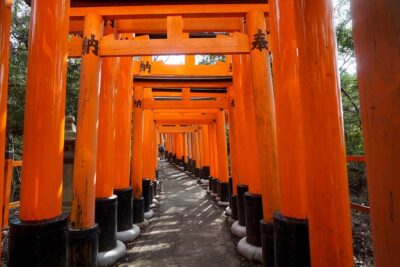
Fushimi Inari Hidden Hiking Tour (Private Option Available)
Read our review →
Nara, Fushimi Inari Taisha, Arashiyama Bus Tour
Read our review →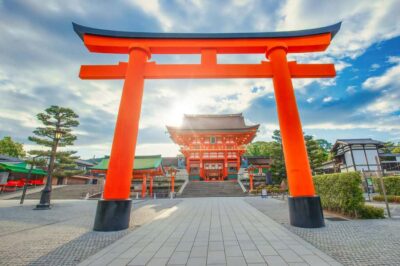
Arashiyama, Nara & Fushimi Inari Shrine w/Lunch
Read our review →
Nijo Castle, Kiyomizu & Fushimi Inari Guided Tour
Read our review →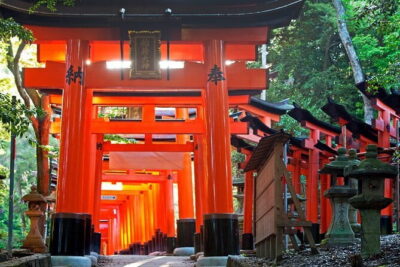
Nijo, Kinkaku-ji, Arashiyama, Kiyomizu & Fushimi Inari
Read our review →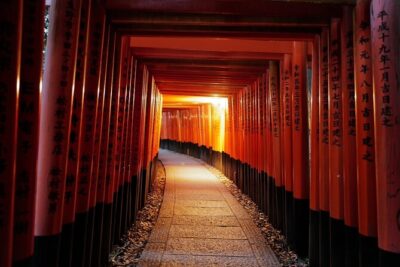
Browse the lists this tour appears in