
Reviewed · KYOTO GEISHA TOURS
Authentic Maiko Experience&Kyoto Dinner (Free drink) at Noh Stage
The most unusual part of this Kyoto evening is the chance to meet a maiko in a small group, not simply watch her dance from a distance. At a Noh stage in Okazaki, you’ll share dinner, hear live shamisen, ask questions and try traditional ozashiki games in the same room.
I like two things in particular: the live shamisen accompanying the dance and games, and the unhurried time to talk with the maiko about her kimono, hair ornaments and work. The meal and unlimited drinks are included, too, which makes the $150 price easier to assess as a full evening rather than a short performance.
One consideration: this is a carefully arranged cultural program, not an invitation into a private teahouse. The group can reach 20 people, and you’ll need to wear socks or tabi to step onto the Noh stage. Bare feet and oversized luggage are not allowed.
Key points before you book
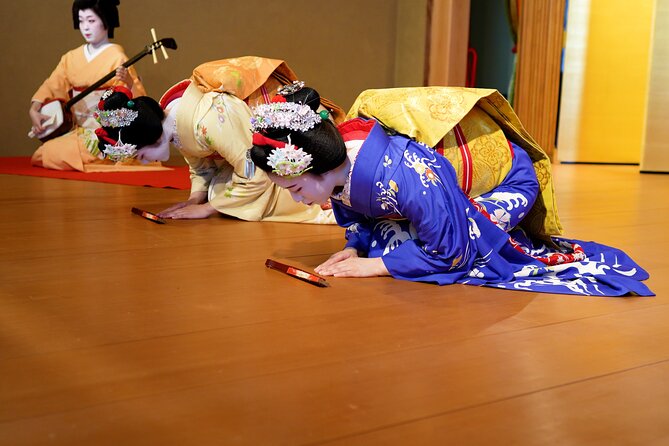
- The maiko performs on a Noh stage to live shamisen, with more than one dance performance described by some participants.
- Dinner, unlimited drinks and the cultural program are included in the $150 price.
- Conversation is a central part of the evening, with introductions, questions about kimono and kanzashi, photos and games.
- The group is capped at 20, and the program runs only with at least two participants.
- Arrive ready for the stage: wear socks or tabi, and keep food and drinks off the Noh stage.
- The evening runs from 6 to 8 pm at Okazaki-an in Kyoto’s Sakyo Ward, ending at the meeting point.
A maiko evening with more conversation than spectacle
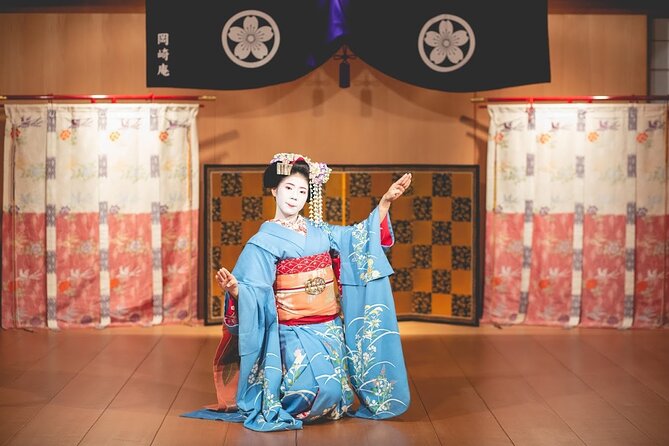
Maiko are apprentice performers in Kyoto’s traditional geiko world. Their work includes dance, music, conversation and formal hospitality, and this program is designed to give you a taste of that broader setting rather than offer a dance recital alone.
That distinction matters. If you only want a brief stage show, this two-hour event may feel like more than you need. But if you want to understand something about the person behind the performance, the chance to ask questions and share a meal is the point.
The evening takes place at Okazaki-an, a historic house with a Noh stage. The stage gives the dance a formal setting, while the small-group format allows for interaction after the performance. The experience is limited to 20 people, a modest size by show standards, though not a private gathering. You may share the conversation and games with a number of other participants.
A Kyoto-certified interpreter guide helps explain the proceedings. That support is useful because the evening includes gestures, clothing and customs whose meaning may not be obvious if you are seeing them for the first time. A past participant also specifically valued English interpretation, though you should confirm the language arrangements when booking if that detail is essential to you.
More geisha and maiko experiences in Kyoto:
- Kyoto Geisha Walking Tour: Gion District & Hidden Gems
★ 4.7 · 3,273 reviews - Kyoto: Gion Magical Night Walking Tour with Geisha Trivia
★ 4.9 · 2,393 reviews - Kyoto: Gion Geisha District Walking Tour – Stories of Geisha
★ 4.7 · 2,187 reviews
From the café to the Noh stage
Doors open at 5:50 pm. If you arrive early, you can wait in the first-floor café space, then gather on the second floor at 6 pm. The location is near public transportation, but transport to the venue is not included, so allow time to find the address: Okazaki-an, 9165 Okazaki Enshōjichō, Sakyo Ward, Kyoto.
Before dinner, there is a chance to take photos on the Noh stage. This is a useful moment to get a picture of the setting before the formal program begins. You must wear socks or tabi on the stage, and eating or drinking there is not allowed. If you plan to take photos, make sure your phone or camera is ready, but follow the staff’s instructions about where and when photography is appropriate.
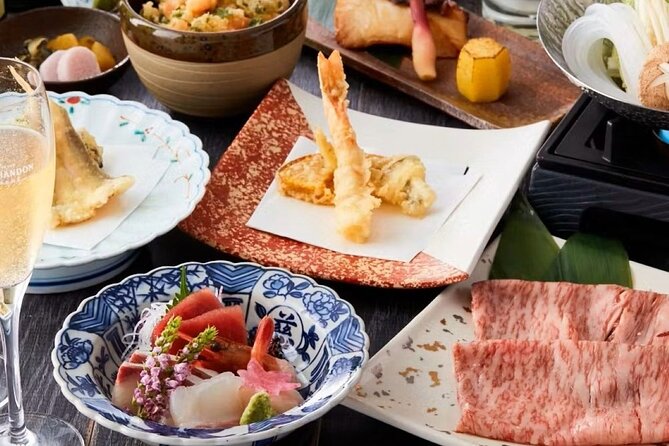
A welcome toast marks the start of dinner. The meal is described as Kyoto traditional food and kaiseki-style cuisine. Kaiseki is a formal Japanese meal shaped by season, balance and presentation, so it is more than a plate of food served between activities. The precise menu is not specified, and you should not assume you can request particular dishes or dietary changes without checking in advance.
Dinner is part of the value calculation. At $150, you are paying for a full two-hour cultural program, a meal, unlimited drinks, live music and direct interaction, not just admission to a performance. If you would otherwise book a special dinner and a separate cultural show, this bundled format may make sense. If your main priority is a low-cost introduction to maiko dance, it is a substantial expense.
Dance and shamisen, close enough to notice the details
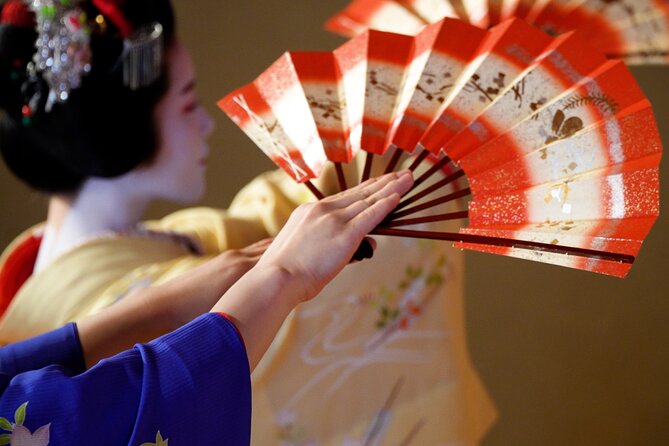
After the meal begins, the maiko enters with a jikata, a musician who accompanies the performance on shamisen. The dance takes place on the Noh stage with live music rather than recorded backing. Some of the most powerful details in a traditional dance can be small: a turn of the wrist, the fall of a sleeve or the way a fan is held. Seeing those movements from nearby gives you a better chance to notice them than a large theater setting would.
More than one dance performance may be part of the evening. The exact number is not specified, so treat the dances as a highlight rather than expecting a fixed-length recital. The program’s real strength is the mix: performance, explanation and conversation all share the evening.
The live shamisen returns during the ozashiki games later on. That link between music and play helps the event feel less like a sequence of unrelated attractions. Still, keep your expectations measured. You are being introduced to elements of traditional hospitality in a planned public program; you are not attending a private gathering at a teahouse.
Ask about the kimono, kanzashi and life as a maiko
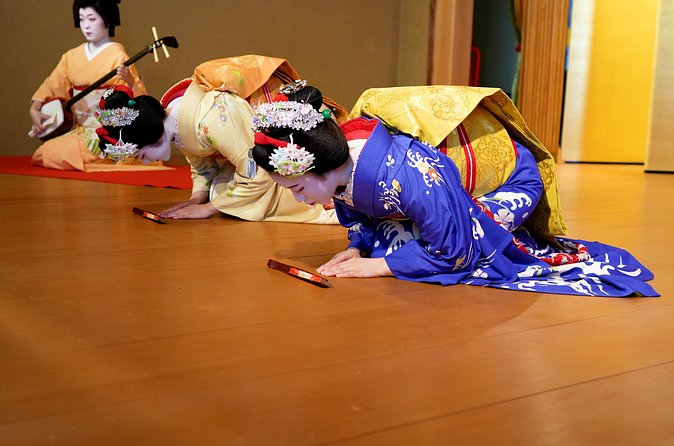
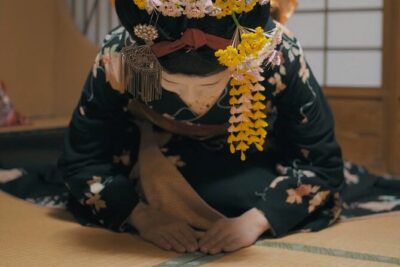
After the dance, the maiko and participants introduce themselves. There is time for questions, including an explanation of the kimono and kanzashi, the decorative hair ornaments that form part of the maiko’s appearance. This is where the evening can shift from watching to learning.
The chance to ask questions face to face is one of the clearest reasons to choose this event over a performance-only show. You might ask about the costume, the dance, training or daily life, though the exact topics depend on the maiko and the conversation. A Kyoto-certified interpreter guide can help bridge the language gap and explain details that might otherwise pass by quickly.
The program also includes a two-shot photo with the maiko on the stage. That is a more personal keepsake than a distant stage picture, and some participants have appreciated receiving a small gift as a memento. A gift is not listed as a guaranteed inclusion, however, so book for the experience itself rather than expecting one.
Photography is a special part of the evening, but it should not become the whole evening. Be attentive, follow instructions and make room for others. The best memory may be the exchange you have, not the number of images on your phone.
More food tours in Kyoto:
- Ramen Cooking Class at Ramen Factory in Kyoto
★ 5.0 · 1,937 reviews - Kyoto Night Foodie Tour in Gion (9+ dishes + 6 Sake tastings)
★ 5.0 · 1,762 reviews - Kyoto: Izakaya Bars Guided Walking Tour
★ 4.9 · 815 reviews - Sushi Making in Kyoto! Same-day bookings welcome!
★ 5.0 · 713 reviews
Ozashiki games bring the room together
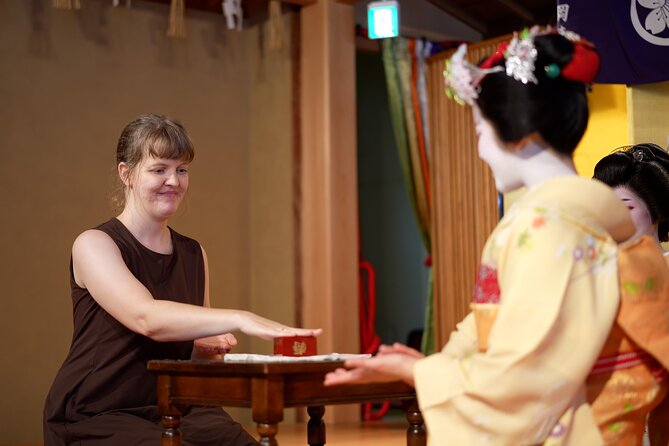
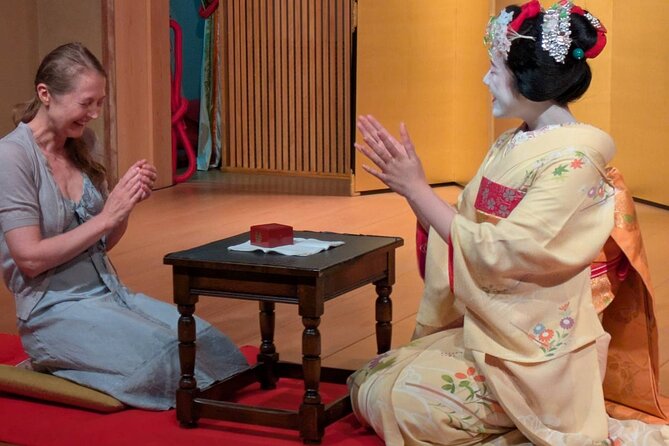
The evening closes with traditional ozashiki games on the Noh stage, accompanied by live shamisen. These games are a playful part of the social world associated with geiko and maiko hospitality. Their appeal is not simply the rules; it is the shared rhythm of music, attention and good humor.
You do not need to arrive knowing how to play. The format is intended to let participants take part, and the interpreter guide can help explain what is happening. Still, this is a group activity, so you should be comfortable joining in or watching others have a turn. If you prefer a quiet, formal concert, this part may feel less suited to you.
The social element is also what makes the small-group limit meaningful. With no more than 20 participants, there is room for interaction that would be hard to manage in a hall full of people. Twenty is still enough for a lively room, though, so do not expect a one-on-one conversation throughout the evening.
The event ends at 8 pm and returns to the meeting point. That fixed finish makes it relatively easy to plan around dinner or an evening walk, but keep in mind that the meal is already part of the program.
Is $150 good value?
I’d judge the price by how much you value access and context. The package includes a traditional meal, unlimited drinks for two hours, dance performances, live shamisen, a guided introduction, conversation, a photo and games. Those pieces add up to a fuller cultural evening than a short show ticket.
The strongest value is the personal access. Several participants have singled out the chance to speak directly with the maiko, ask questions and learn about her life as the most memorable part. The performance is important, but the conversation is what can turn a beautiful display into a more meaningful encounter.
The price will feel less attractive if you mainly want dinner or a quick photo. It is also not the right fit if you expect a fully private setting, since the group can include up to 20 people. But for a special Kyoto evening, particularly if this is your first chance to see maiko dance, the combination of meal, music and interaction makes the cost easier to justify.
Practical details that shape the evening
The experience lasts about two hours, from 6 to 8 pm, with doors opening ten minutes earlier. It requires at least two participants and has a maximum group size of 20. The activity ends back at the meeting point, and private transportation to the venue is not included.
Wear socks or tabi if you want to step onto the Noh stage. Bare feet are not allowed, and oversized luggage is not accepted. The venue is near public transportation, but the precise route depends on where you are staying, so check your journey before setting out.
Most people can participate, but the event involves moving onto a stage for photos and games. If you have a specific mobility concern, ask the operator before booking rather than assuming the space will suit your needs. Confirmation is provided at booking. Free cancellation is available up to 24 hours before the start time; changes or cancellations inside that window are not accepted, and the amount paid is not refunded.
Should you book this maiko experience?
Book it if you want more than a dance performance and are curious about Kyoto’s traditional arts, clothing and hospitality. The strongest reasons are the live shamisen, the chance to ask questions and the chance to take part in games, all within one evening and with dinner and drinks included.
Skip it if you want a low-cost show, need a private encounter or are not comfortable with a group activity. For most visitors looking for a special cultural evening, though, this is a thoughtful way to meet a maiko respectfully and get a little context along with the spectacle. Bring your curiosity, wear socks and leave enough space in your evening to enjoy the conversation.
FAQ
How long does the experience last?
The program runs from 6 to 8 pm, about two hours. Doors open at 5:50 pm.
Where does the experience start and end?
It starts at Okazaki-an, 9165 Okazaki Enshōjichō, Sakyo Ward, Kyoto, and ends back at the meeting point.
What is included in the price?
The price includes meals, unlimited drinks for two hours, maiko dance performances, live shamisen, conversation, a two-shot photo and ozashiki games.
What should I wear to step onto the Noh stage?
You need to wear socks or tabi. Bare feet are not allowed, and food and drinks are not permitted on the stage.
How many people can join?
The experience requires at least two participants and allows a maximum of 20.
Can I cancel for a full refund?
Yes, if you cancel at least 24 hours before the start time. Cancellations or changes made less than 24 hours beforehand are not accepted, and cancellations within that period are not refunded.
More dining experiences in Kyoto
- Private Dinner with a Geisha
★ 5.0 · 65 reviews - Kyoto Evening Gion Food Tour Including Kaiseki Dinner
★ 5.0 · 62 reviews - Kyoto: Maiko Dinner in Traditional Restaurant and Tour
★ 4.8 · 55 reviews - Kyoto: Lunch or Dinner with Maiko
★ 4.2 · 52 reviews
More evening meals in Kyoto
- Kyoto Gion Cultural Walk & Geisha Show with Dining Options
★ 5.0 · 518 reviews - Kyoto Gion Cultural Walk & Geisha Show with Dining Options
★ 5.0 · 483 reviews - Dinner with Maiko in a Traditional Kyoto Style Restaurant Tour
★ 5.0 · 175 reviews - Kyoto: Geisha Dinner & Gion Cultural Walk
★ 5.0 · 73 reviews
Newly added in Kyoto
- Uji: Private immersion into Kyoto’s tea and reglious culture★ 5.0 · 17 reviews
- Whisk Your Own Matcha: A Zen Matcha Experience at Temple★ 3.6 · 7 reviews
- Kyoto tea town for matcha lovers★ 5.0 · 16 reviews
- Treasures of Kyoto: Gion & historical Walking Tour★ 5.0 · 6 reviews
- Kyoto Matcha Green Tea Tour★ 4.5 · 23 reviews
- Uji and Wazuka Matcha Farm Half Day Private Guided Tour★ 5.0 · 21 reviews
- Uji Tea Ceremony and UNESCO Heritage Walking Tour★ 5.0 · 20 reviews
- Utilising upcycled Matcha! Creating matcha incense (Uji, Kyoto)★ 5.0 · 6 reviews
Kyoto Geisha Tours, compared.
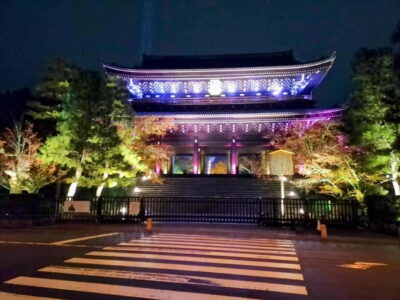
Kyoto Geisha Walking Tour: Gion District & Hidden Gems
Read our review →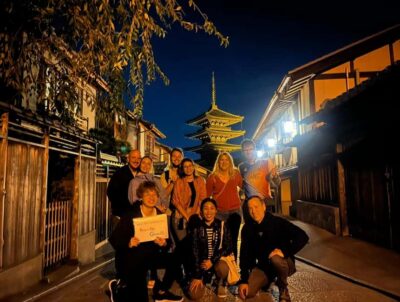
Gion Magical Night Walking Tour with Geisha Trivia
Read our review →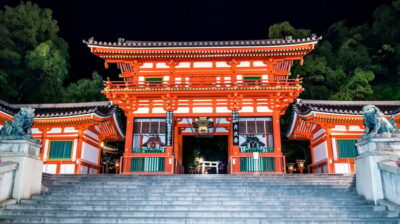
Gion Geisha District Walking Tour – Stories of Geisha
Read our review →
Best of Kyoto: Gion, Geisha, Pagodas & Cobblestones
Read our review →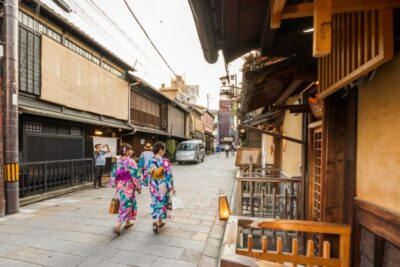
Kyoto Gion Cultural Walk & Geisha Show with Dining Options
Read our review →
Browse the lists this tour appears in