
Reviewed · KYOTO WALKING TOURS
Kyoto Late Bird Walking Tour
Fushimi Inari’s long rows of red torii gates are one of Kyoto’s signature sights, and this private afternoon tour links them with Yasaka Pagoda, Yasaka Shrine, and Gion. I like two things in particular: a guide helps turn a string of famous places into a connected visit, and the private format gives your group room to ask questions and set a comfortable pace.
The main consideration is the price: $86.49 per person does not include public transportation or food and drink. The tour is about four hours, starts at 2 p.m. at Kyoto Station, and returns there, so it suits you if you want a guided afternoon rather than a full day of sightseeing.
At a glance
- A private tour for your group: You will not be paired with other tour parties.
- Four major stops: Fushimi Inari, Yasaka Pagoda, Yasaka Shrine, and Gion are on the planned route.
- Public transit is part of the outing: Budget ¥850 per person for transport, separate from the tour price.
- Guides bring the day to life: Previous guides have included Kaz, Saori, Key, Mitsue, and Meg.
- Gion offers a chance, not a promise: You might see a geisha or maiko, but sightings are not guaranteed.
- The tour finishes where it begins: Meet at Kyoto Station at 2 p.m. and return there at the end.
A guided afternoon that links far-flung sights
Kyoto’s sights are spread across the city, and this tour makes a practical half-day route of several that can take more planning to connect on your own. You start at Kyoto Station, then travel to Fushimi Inari before continuing to the eastern Kyoto stops. Your guide handles the commentary and helps you navigate between them.
The four listed visits add up to about two hours and 40 minutes: one hour at Fushimi Inari, 30 minutes at Yasaka Pagoda, 20 minutes at Yasaka Shrine, and 50 minutes in Gion. The four-hour total leaves time for transit and moving between locations. You are not simply being led from one photo spot to the next; the guide can explain what you are seeing as the city changes around you.
It is a private activity, so the group is only yours. That matters if you like to ask questions, pause to look around, or keep the conversation moving at your own pace. It does not mean the tour is fully customizable, so if you have a particular priority, such as more time in Gion, raise it with your guide at the start.
More walking tours in Kyoto:
- Kyoto Geisha Walking Tour: Gion District & Hidden Gems
★ 4.7 · 3,273 reviews - Kyoto: Gion Magical Night Walking Tour with Geisha Trivia
★ 4.9 · 2,393 reviews - Kyoto: Gion Geisha District Walking Tour – Stories of Geisha
★ 4.7 · 2,187 reviews
Fushimi Inari’s rows of red gates
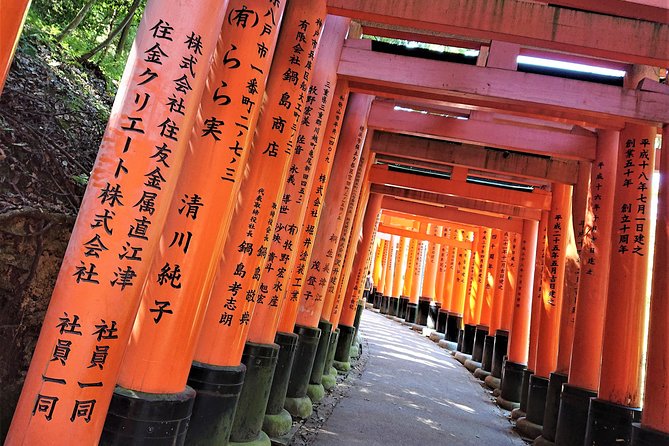
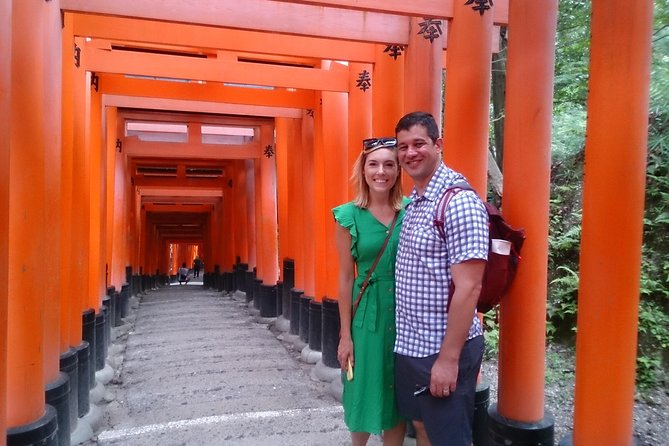
The first stop is Fushimi Inari-taisha, famous for its thousands of vermilion torii gates. Worshippers donated the gates in thanks for good fortune, giving the shrine’s best-known feature both visual impact and a clear connection to the religious life of the site.
The tour allows one hour here, the longest stop of the afternoon. That gives you a meaningful window to see the gates and hear about the shrine, without turning the visit into a long hike. The description focuses on the striking gate passage, not a climb to the summit, so do not assume the tour includes a full mountain visit.
This is an especially useful place to have a guide. A photograph can capture the repeated red frames, but commentary helps explain why they are there and what they represent. If you have a question about the shrine or its customs, a private tour gives you a natural chance to ask it.
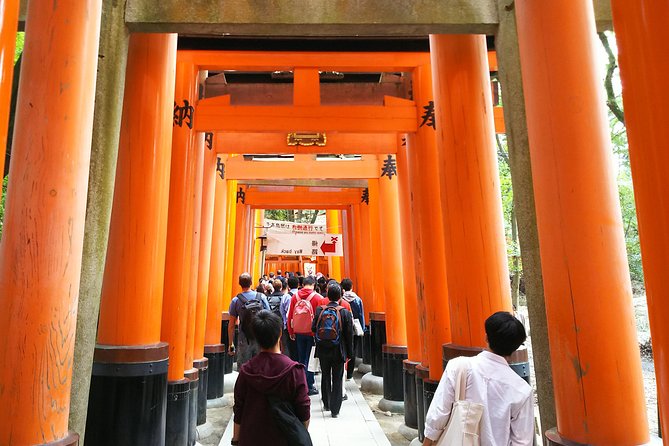
The stop is also the one most likely to feel crowded, since the gates are so famous and picturesque. Your guide can help you make the most of the time available, but the tour cannot promise a quiet or empty stretch of path.
Yasaka Pagoda and the old Kyoto view
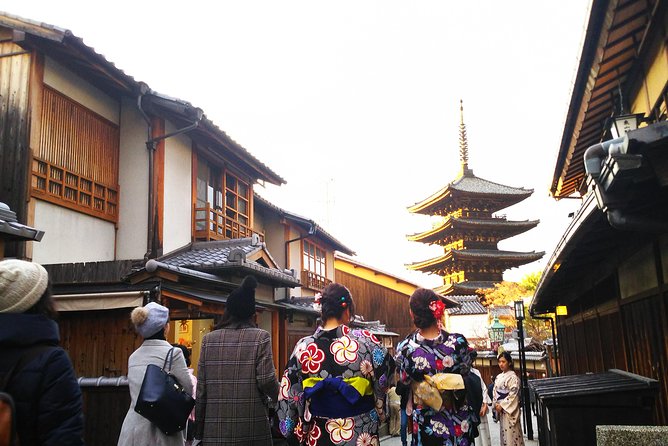
Next comes Yasaka Pagoda, also known as Yasakanoto. The pagoda was first built in 592 and rebuilt in 1440, and the area around it offers one of the views most associated with old Kyoto. The planned stop is 30 minutes.
That half hour is enough for a look and photographs, but not a long visit. The pagoda and its surroundings are a strong contrast with Fushimi Inari: instead of a series of gates leading through a shrine, you get a historic structure set within the city’s older streets.
Evening can draw photographers to this area, according to the tour description. Since the tour begins at 2 p.m. and the full outing lasts about four hours, the precise light and crowd levels will depend on the date and pace. Treat the stop as a chance to take in the setting, not as a guaranteed photo session under ideal conditions.
Yasaka Shrine and a local connection
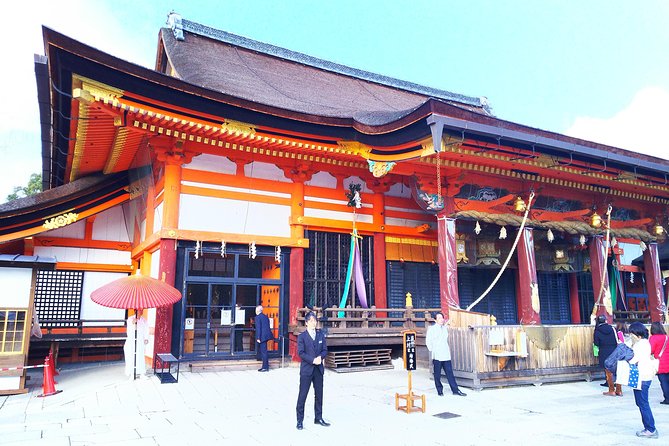
Yasaka Shrine gets a shorter, 20-minute visit. It was once called Gion Shrine, and the name Gion grew from the shrine’s former name. The main deity is described as powerful, and a deity of beauty is also enshrined here.
That link between the shrine and the surrounding district gives the stop more meaning than a quick look at another landmark. Your guide can explain the connection as you walk, helping you see how Kyoto’s place names and religious sites are tied together.
Twenty minutes is brief, so this is not a deep or leisurely shrine visit. It works best as a concise stop on a broader route, particularly if you want to see several parts of Kyoto in one afternoon rather than spend the day at a single site.
More Kyoto tours in Kyoto:
- PERFECT KYOTO 1-Day Bus Tour
★ 5.0 · 13,518 reviews - Kyoto: Fushimi Inari, Kinkakuji, Bamboo Grove 1 Day Bus Tour
★ 4.8 · 4,316 reviews - Kyoto: Tea Ceremony in a Traditional Tea House in Kiyomizu
★ 4.9 · 3,519 reviews - Kyoto: Tea Ceremony Ju-An at Jotokuji Temple
★ 4.9 · 3,207 reviews
Gion, geisha culture, and respectful expectations
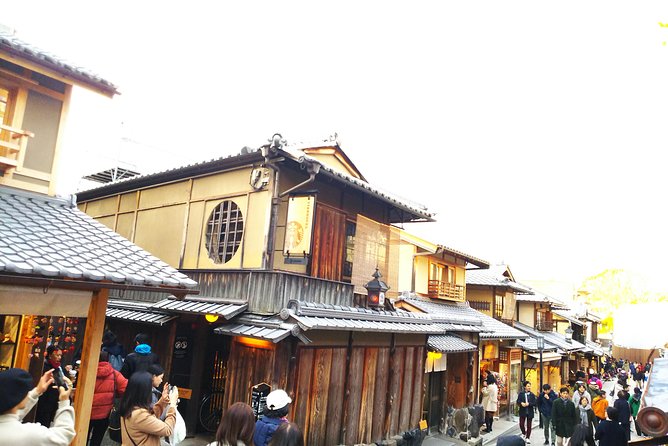
The final planned stop is Gion, with about 50 minutes to walk through its preserved old-style houses and streets. Geisha and maiko, their apprentices, remain part of the district’s traditional culture. You may spot one, but the tour cannot guarantee a sighting, and it is best to value Gion for its architecture and atmosphere as well as the possibility.
Past outings have included lucky encounters with geisha and trainees. One guide, Saori, was also able to share snacks during an afternoon, but food is not included in the tour price, and you should not count on this being part of every visit. The core offering is a guided walk, not a tasting tour.
Gion is a good place to ask questions about the distinction between geisha and maiko, and about the traditions you see around you. Your guide’s commentary can add context, while the private format makes it easier to talk without having to compete with a large group.
A past route has also included Yasui Konpira-gu, where a guide translated a humorous paper wish. That stop is not among the four planned itinerary visits, so consider it an example of a place that may come up on a particular outing, not a promised inclusion.
Guides and the value of having one
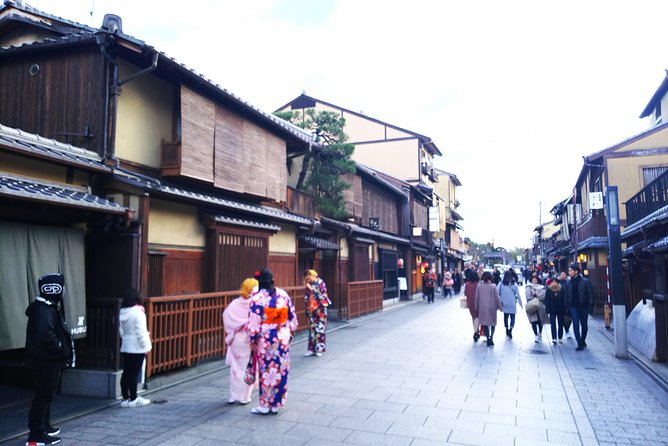
The guides associated with this tour include Kaz, Saori, Key, Mitsue, and Meg. Your assigned guide may be someone else, and a particular person is not guaranteed. What matters most is that the guide does more than point out landmarks: the strongest accounts of the tour describe clear explanations, good conversation, and a relaxed pace.
Saori has been described as enthusiastic, with strong English and Japanese and an easy conversational style. Mitsue led a relaxed outing and clearly pointed out places of interest before the group arrived. Meg was praised for her punctual welcome at the station and broad explanations, while Key was singled out for an excellent tour. These examples suggest that the guide is a major part of the experience, not just someone who escorts you between stops.
There is a practical benefit, too. One outing used several trains, and a visitor recommended bringing a loaded IC card. Public transport is not included in the tour price, and the stated fare is ¥850 per person. A prepaid transit card can make the ride simpler, but the tour information does not require one, so you can also plan to pay fares as needed.
Is $86.49 per person good value?
At $86.49 per person, you are paying for a private guide over about four hours, not for admissions, meals, or transportation. The listed shrine and neighborhood stops have no admission ticket charge, while public transit is an extra ¥850 per person. Food and drink are also on your own.
The value depends on what you want from the afternoon. If you are comfortable finding your own way around and mainly want to see the landmarks, you can avoid the guide fee by visiting independently. If you want someone to explain the sites, handle the connections between them, and keep the outing moving, the private format can be worth the extra cost, especially for a group that can share the fee.
The tour’s advantage is efficiency with context. In four hours, you cover four distinct places and get a guide’s commentary along the way. The trade-off is limited time at each stop, particularly the 20 minutes at Yasaka Shrine, and a fare that is not bundled into the quoted price.
Timing, access, and a few things to plan
The tour starts at 2 p.m. at Kyoto Station and ends back at the meeting point. Arrive on time and confirm the precise meeting instructions with the operator before setting out. One person who arrived late was still met by the guide, but that was a kindness, not a sensible plan to rely on.
The tour is described as accessible for people with limited eyesight and limited mobility, but it is not stroller accessible. If you have a specific mobility need, ask KAMNAVI Tours what the route involves before booking. The supplied information does not give details about walking distances or surfaces, so do not assume that every segment will suit your needs without checking.
Animals and pets are allowed. The tour requires good weather; if poor weather forces cancellation, you can be offered another date or a full refund. You can cancel for a full refund up to 24 hours before the start time. Less than 24 hours’ notice means no refund, and changes inside that window are not accepted.
Who should book this Kyoto walking tour?
I would consider this tour if you have one free afternoon, want a guide’s explanation, and prefer to let someone else manage the route between major sights. It is also a good fit for a small party that enjoys conversation and wants the flexibility of a private outing rather than a group tour with strangers.
It is less suitable if you want a long, unhurried visit at each shrine, a guaranteed geisha sighting, or transport and refreshments included in the price. The afternoon packs in several landmarks, so the experience is more about connecting places and learning as you go than lingering for hours at any one site.
Book it if guided context and easy coordination matter more to you than keeping the cost down. If you are happy to navigate Kyoto independently and are mainly after the famous views, put the extra money toward your own transit and take the stops at your preferred pace.
FAQ
How long is the Kyoto Late Bird Walking Tour?
The tour lasts approximately four hours.
What time does the tour start?
It starts at 2 p.m.
Where does the tour meet and finish?
The meeting point is Kyoto Station in Kyoto. The activity ends back at the meeting point.
Which places are included in the planned route?
The planned stops are Fushimi Inari-taisha Shrine, Yasaka Pagoda, Yasaka Shrine, and the Gion district.
Is this a private tour?
Yes. It is a private activity for your group only.
Is public transportation included in the price?
No. Public transportation is not included. The listed fare is ¥850 per person.
What is included in the tour price?
The guide fee is included. Food, drinks, and public transportation are not included.
Can I cancel for a refund?
You can cancel for a full refund if you cancel at least 24 hours before the tour’s start time. If poor weather cancels the experience, you will be offered a different date or a full refund.
Newly added in Kyoto
- Uji: Private immersion into Kyoto’s tea and reglious culture★ 5.0 · 17 reviews
- Whisk Your Own Matcha: A Zen Matcha Experience at Temple★ 3.6 · 7 reviews
- Kyoto tea town for matcha lovers★ 5.0 · 16 reviews
- Treasures of Kyoto: Gion & historical Walking Tour★ 5.0 · 6 reviews
- Kyoto Matcha Green Tea Tour★ 4.5 · 23 reviews
- Uji and Wazuka Matcha Farm Half Day Private Guided Tour★ 5.0 · 21 reviews
- Uji Tea Ceremony and UNESCO Heritage Walking Tour★ 5.0 · 20 reviews
- Utilising upcycled Matcha! Creating matcha incense (Uji, Kyoto)★ 5.0 · 6 reviews
Kyoto Walking Tours, compared.
Kyoto Geisha Walking Tour: Gion District & Hidden Gems
Read our review →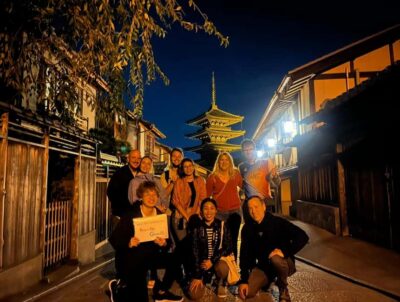
Gion Magical Night Walking Tour with Geisha Trivia
Read our review →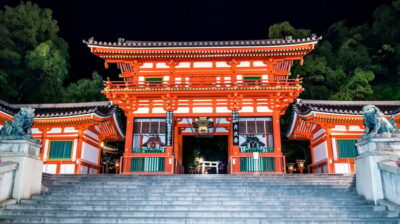
Gion Geisha District Walking Tour – Stories of Geisha
Read our review →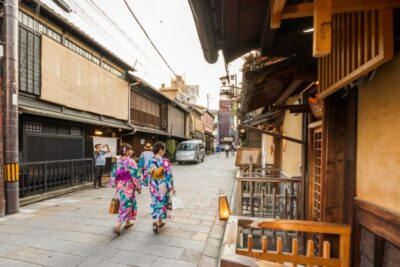
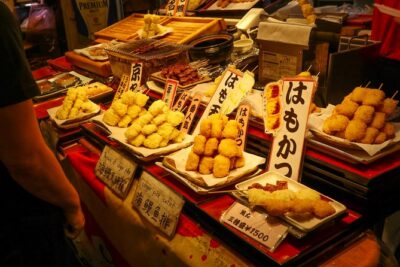
Nishiki Market Brunch Walking Tour (7 Tastings + Brunch)
Read our review →
Kyoto Arashiyama Walking Tour: Bamboo, Monkeys, Gardens & Secrets
Read our review →
Nara Half Day Trip Walking Tour (Private Option Available)
Read our review →Browse the lists this tour appears in