
Reviewed · KYOTO GEISHA TOURS
Simple Plan with Maiko
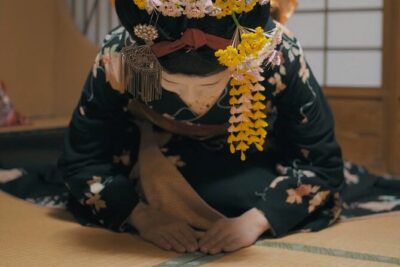
A maiko’s world is usually glimpsed from a distance. Here, you can watch her demonstrate tea ceremony etiquette, see two dances up close, and ask her questions about her life and work. The program lasts 90 minutes and costs $38 per person.
I like two things in particular: the question-and-answer session gives the meeting real substance, and the game turns a formal cultural presentation into a shared, good-natured event. The photo beside the maiko and the senjafuda charm make for a personal keepsake, too.
The main consideration is what the basic ticket does not include. You watch a tea ceremony, but you do not make tea, and snacks and drinks cost extra. Seating can also affect your view of the dance, so consider a paid seat upgrade if seeing every movement matters to you.
- Ask the maiko directly: The Q&A is a central part of the program, with English translation offered as much as possible.
- Watch, rather than make, matcha: The tea ceremony is a demonstration. Hands-on tea preparation is part of a different, premium program.
- See two traditional dances: Their themes may draw on the seasons, love stories, or everyday life.
- Join a simple game: Volunteers can play with the maiko, while everyone else can clap and cheer.
- Plan for paid extras: Snacks and drinks cost 500 yen; reserved seat upgrades range from 1,100 to 3,300 yen.
- Expect a modern venue: It is in a building, not a traditional teahouse, and you must use the stairs because there is no elevator.
A rare chance to ask a maiko questions
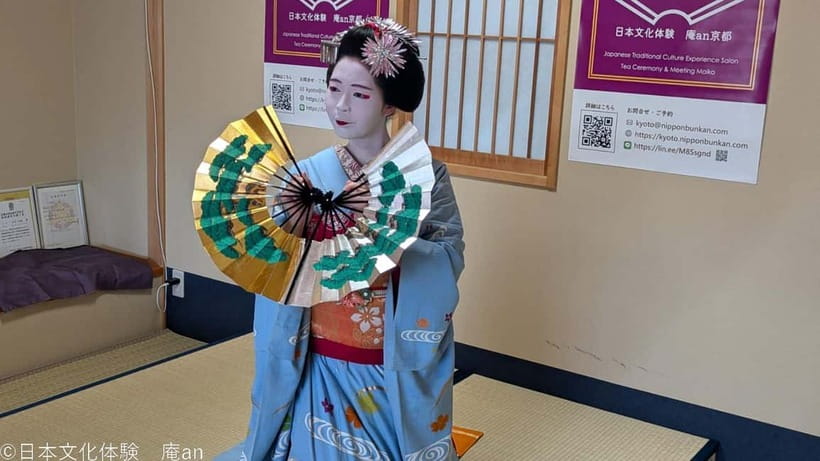
Maiko are apprentices in the world of traditional Japanese dance and entertainment. Their clothing, hairstyles, training, and daily routines are part of a living tradition, and this program is designed to let you learn about that world through a direct encounter rather than a stage performance alone.
The best part is the chance to ask questions. You are not limited to watching from your seat and guessing what the details mean. You can ask the maiko about her daily life and work, then hear her answers through the host’s translation when available. The instructor language is Japanese, so contact the organizer in advance if you would like English translation added. Translation is offered as much as possible, but should not be assumed to be constant or exhaustive.
No individual maiko is named in advance, and the program may feature a geiko instead, depending on circumstances. Both are trained performers in Kyoto’s traditional arts, but the distinction matters if you have a specific reason for wanting to meet a maiko. If that is essential to your plans, contact the organizer before booking.
Tea ceremony etiquette, without the hands-on lesson
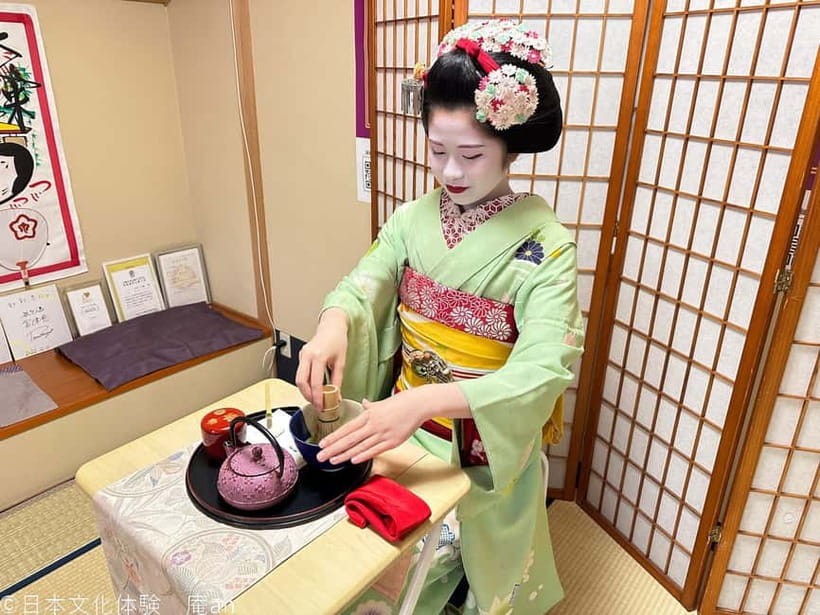
The program opens with a greeting from the maiko, followed by a tea ceremony demonstration. Watch the precise movements and etiquette, and notice how the ceremony gives space to small gestures and careful attention. Even if you have already attended a tea ceremony, seeing a maiko perform it gives the ritual a different context.
This is not a make-your-own-matcha session. You will not prepare tea yourself, and the basic ticket does not include a snack or drink. If you want to take part in making tea, choose the separate Tea Ceremony with Maiko Premium program. If you simply want to observe the form and then ask questions, this simpler plan may be the better fit.
The setting is informal rather than ceremonial in the architectural sense. The venue is in a building, not an ochaya or traditional Japanese house. That may disappoint anyone expecting a classic teahouse interior, but a relaxed room and friendly staff can make it easier to listen, ask questions, and enjoy the program without worrying about special customs.
More geisha and maiko experiences in Kyoto:
- Kyoto Geisha Walking Tour: Gion District & Hidden Gems
★ 4.7 · 3,273 reviews - Kyoto: Gion Magical Night Walking Tour with Geisha Trivia
★ 4.9 · 2,393 reviews - Kyoto: Gion Geisha District Walking Tour – Stories of Geisha
★ 4.7 · 2,187 reviews
The question session is the heart of the program
After the tea demonstration, the maiko takes questions. This is where the experience moves beyond costume and performance. You can ask about the routines behind her appearance and the work involved in maintaining a traditional way of life today.
Come with a few questions in mind. You might be curious about her training, the meaning of her clothing, or what a typical day involves. The program does not promise that every question can be translated word for word, but the host can help make the exchange more accessible. Questions are also a good way to understand the difference between simply seeing a performance and meeting the person behind it.
The session is especially useful if you have already done a standard tea ceremony and want something more personal. It also gives first-time visitors a way to connect the dances and ritual they see with the culture that sustains them. Keep expectations realistic: this is a short introduction, not an exhaustive lesson in Kyoto’s traditional arts.
A photo, a charm, and two dances
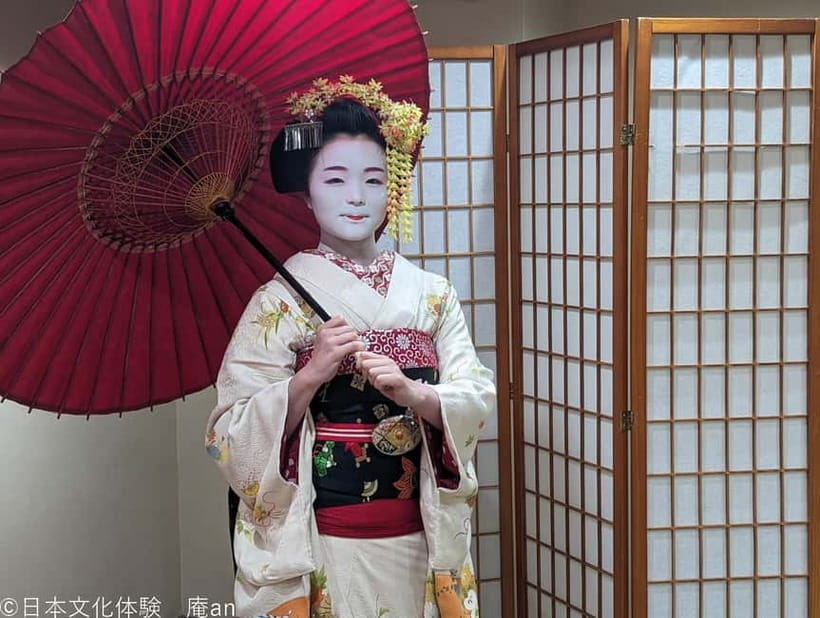
After the Q&A, you can take a commemorative photo beside the maiko. The chance to stand close makes this more personal than photographing a distant stage, though be ready to follow the host’s instructions so the photo portion moves smoothly.
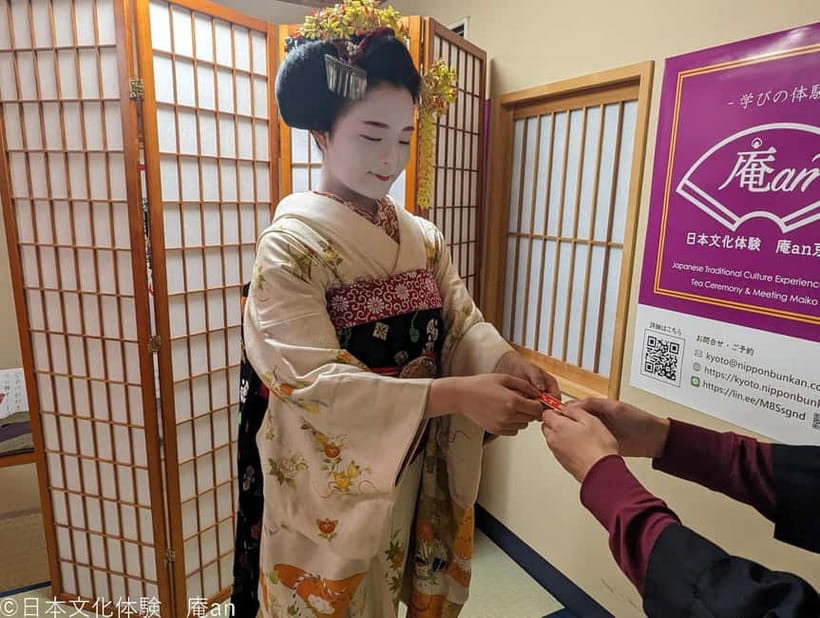
The maiko also presents a senjafuda, a small lucky charm and a tangible reminder of the meeting. It is a thoughtful touch, especially for an experience that otherwise centers on watching and listening.
Next come two traditional dances. Their themes may express the seasons, love stories, or everyday life. Watch the hands, posture, and controlled movements; the elegance comes from precision, not speed. The room arrangement can affect how well you see. Red-covered tables have obstructed the view for some people, particularly from farther back, so a seat upgrade is worth considering if an unobstructed look at the dance is a priority.
The game brings the room together
The final featured activity is a simple game with the maiko. Volunteers are welcome, but you can enjoy it from your seat if you prefer. The host encourages people to clap and cheer, which helps the room feel less like an audience watching a formal presentation and more like a group sharing a light moment.
If you are shy, decide before the game whether you want to volunteer. It can be easy to wait, then wish you had joined in once the moment has passed. There is no pressure to play, and watching is part of the fun, but stepping forward is the best way to take part.
The game also adds a welcome change of pace after the quieter tea demonstration and dances. It is playful rather than demanding, and it gives you one last chance to interact with the maiko before she leaves the room.
More Kyoto tours in Kyoto:
- PERFECT KYOTO 1-Day Bus Tour
★ 5.0 · 13,518 reviews - Kyoto: Fushimi Inari, Kinkakuji, Bamboo Grove 1 Day Bus Tour
★ 4.8 · 4,316 reviews - Kyoto: Tea Ceremony in a Traditional Tea House in Kiyomizu
★ 4.9 · 3,519 reviews - Kyoto: Tea Ceremony Ju-An at Jotokuji Temple
★ 4.9 · 3,207 reviews
What the $38 price includes, and what it does not
At $38 per person, the simple plan is a relatively affordable way to see a maiko perform, ask questions, take a photo, receive a senjafuda, and join a game. The value is strongest if you are interested in personal interaction and cultural context, not just a tea service or a dance show.
The base price includes the 90-minute program. It does not include snacks or drinks, which are offered for 500 yen, or the seating upgrades: SS first-row seats cost 3,300 yen, S2 second-row seats cost 2,200 yen, and S3 third-row seats cost 1,100 yen. These are paid options, so calculate the total before booking if refreshments or a particular view matter to you.
The distinction between the simple plan and a hands-on tea ceremony is important. If you expect to whisk matcha, or to be served tea and a sweet as part of the basic price, this may not meet your expectations. Think of the ticket as payment for a hosted cultural program, with food and better seating available at extra cost.
Timing, location, and practical details
The meeting point is a one-minute walk from Exit 1 of Gojo Station on Kyoto’s Karasuma subway line. The entrance faces Gojo-dori, so you should not need a long walk from the station. The session itself runs for 90 minutes: the main program ends at about 75 minutes, followed by chatting time before you leave.
The venue is in a building with no elevator, and you must take stairs to reach the rooms. The activity is described as wheelchair accessible, but the stair access appears to conflict with that description. If you use a wheelchair or have trouble with stairs, contact the organizer before booking to confirm what access is available at the venue.
The operating hours are 10:00 to 17:00. Reservations received after 17:00 are processed the next day. The experience may take place alongside people having lunch or dinner, so the room may not be reserved exclusively for this program. Participants who have not booked the experience cannot enter, and children under two can attend free while sitting on a parent’s lap. If a child under two needs their own seat or meal, the same fee as one person applies.
Cancellation is free up to eight days in advance for a full refund. Fees apply after that point, and a date or time change after a cancellation fee has been incurred may also carry a specified charge. Check the terms before booking, and allow time to reach the venue; travel expenses are not reimbursed if you cancel.
Who will enjoy this Kyoto meeting
I would choose this experience if you want to learn about maiko culture through direct conversation, and you are happy to watch rather than participate in the tea ceremony. The Q&A, photo, and game give the session a personal quality that a performance alone would not provide.
It is also a good choice if you want a structured cultural activity that fits into a Kyoto day without taking up several hours. The 90-minute duration makes it relatively easy to plan around other sightseeing, while the short walk from Gojo Station keeps the approach simple.
You may want another option if your priority is making matcha, having tea and a sweet included, or sitting in a traditional Japanese house. And if dance visibility matters more than the Q&A, budget for a seat upgrade or ask the organizer about seating before you commit.
Should you book the Simple Plan with Maiko?
Book it if the chance to ask a maiko questions is your main reason for going, and you want to add a tea ceremony demonstration, two dances, a close-up photo, and a game in one visit. At $38, it offers a direct introduction to a living tradition without the higher cost of a more elaborate program.
Skip it if you expect a hands-on tea lesson or a traditional teahouse setting. For the clearest view, consider the paid seat options, and contact the organizer about translation, accessibility, or whether a maiko rather than a geiko is expected. With those points clear, this is a practical, personable way to meet the people behind one of Kyoto’s best-known cultural traditions.
FAQ
How long does the experience last?
The program lasts 90 minutes. The main activities end at about 75 minutes, followed by chatting time before departure.
Does the program include making matcha?
No. You watch a maiko demonstrate a tea ceremony, but you do not make tea. Hands-on tea preparation is part of the separate Tea Ceremony with Maiko Premium program.
Is a maiko guaranteed to attend?
No. Depending on the situation, a geiko may be invited instead of a maiko.
Can I ask the maiko questions?
Yes. A question-and-answer session is included. English translation is provided as much as possible; contact the organizer if you would like it added.
Can I take a photo with the maiko?
Yes. The program includes a commemorative photo opportunity beside the maiko.
Is food or a drink included?
No. Snacks and drinks are an optional extra costing 500 yen.
How much do upgraded seats cost?
SS first-row seats cost 3,300 yen, S2 second-row seats cost 2,200 yen, and S3 third-row seats cost 1,100 yen.
Where is the meeting point?
It is a one-minute walk from Exit 1 of Gojo Station on the Karasuma subway line. The entrance faces Gojo-dori.
Is the venue accessible by elevator?
No. There is no elevator, and you must take stairs to reach the venue. Contact the organizer if you need to confirm access arrangements.
Can children under two attend for free?
Yes, if they sit on a parent’s lap. If a child under two needs a seat or meal, the same fee as one person applies.
Newly added in Kyoto
- Uji: Private immersion into Kyoto’s tea and reglious culture★ 5.0 · 17 reviews
- Whisk Your Own Matcha: A Zen Matcha Experience at Temple★ 3.6 · 7 reviews
- Kyoto tea town for matcha lovers★ 5.0 · 16 reviews
- Treasures of Kyoto: Gion & historical Walking Tour★ 5.0 · 6 reviews
- Kyoto Matcha Green Tea Tour★ 4.5 · 23 reviews
- Uji and Wazuka Matcha Farm Half Day Private Guided Tour★ 5.0 · 21 reviews
- Uji Tea Ceremony and UNESCO Heritage Walking Tour★ 5.0 · 20 reviews
- Utilising upcycled Matcha! Creating matcha incense (Uji, Kyoto)★ 5.0 · 6 reviews
Kyoto Geisha Tours, compared.
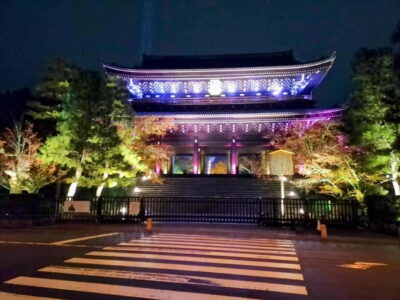
Kyoto Geisha Walking Tour: Gion District & Hidden Gems
Read our review →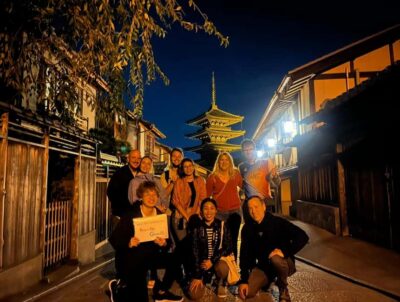
Gion Magical Night Walking Tour with Geisha Trivia
Read our review →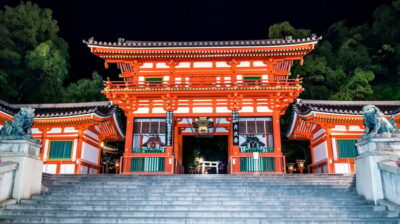
Gion Geisha District Walking Tour – Stories of Geisha
Read our review →
Best of Kyoto: Gion, Geisha, Pagodas & Cobblestones
Read our review →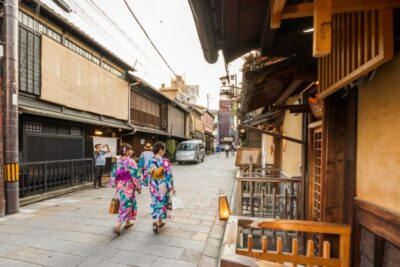

Kyoto Gion Cultural Walk & Geisha Show with Dining Options
Read our review →
Browse the lists this tour appears in