Reviewed · KYOTO TOURS
Authentic knife making experience at a blacksmith in Kyoto
A red-hot piece of steel, a hammer in your hand, and an instructor showing you how to turn each strike into the start of a blade: this is not a blacksmithing demonstration from behind a rope. You take part in making a usable 13 to 15 cm knife, then take it home.
I like two things in particular: you get to handle real tools and experience the hard, rhythmic work of forging, and the finished knife is a useful keepsake rather than a souvenir that stays on a shelf. The instructors, including Mao, guide beginners patiently and give clear safety instructions.
The main consideration is the effort. You’ll stand near a hot furnace, hammer repeatedly, and work on the blade for much of the session. The studio is outside central Kyoto, and there are two possible locations, so confirm your assigned studio before setting out.
- You do the forging: Heat the steel, hammer it into shape, then refine and sharpen the blade with an instructor close by.
- The finished knife is compact: Expect a handmade blade about 13 to 15 cm long, suited to everyday use or a thoughtful gift.
- It takes real work: The session is physical, and the furnace makes the workspace hot. Stretching beforehand is sensible.
- You get a quick introduction to the craft: The workshop covers basic forging and knife-making techniques, but it is a short practical session, not a full blacksmithing course.
- The studio location needs confirming: The meeting point is given as Studio Shinobi YASE, but the operator also uses Studio NIN Yase and Studio NIN Kendo. Check your message before travel.
- Budget for a possible handle upgrade: One past participant reported an extra ¥5,000 for a knife with a handle. Confirm current options and costs with the studio.
A Kyoto workshop where you make the blade
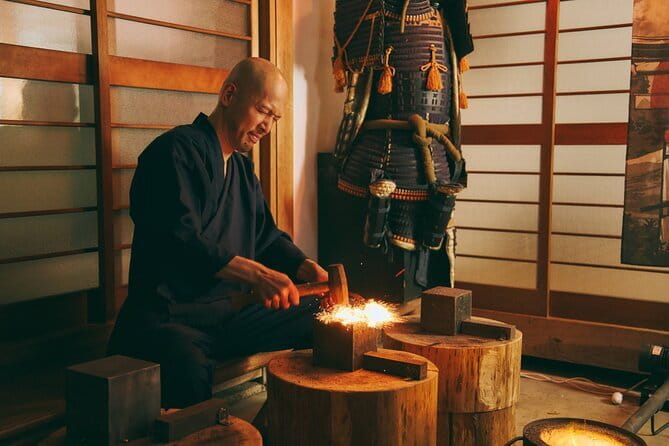
The appeal here is simple: you are not only watching a craftsperson work. Under supervision, you heat steel, strike it with a hammer, refine its shape and sharpen it. At the end, you leave with a knife you helped make, and a better sense of why skilled metalwork takes patience and strength.
The session lasts about three hours. The workshop is also described as a refined 2.5-hour format for making a smaller knife, with larger knives taking more than five hours and costing over $400. That distinction matters: this is a compact introduction to the craft, not a chance to make a large chef’s knife or spend a full day at the forge.
The listed price is $154 per person. That is a substantial fee for a three-hour activity, but it includes the tools, materials, traditional work clothes, water, towel, box and bag, as well as instruction and the finished knife. You are paying for an unusual, hands-on experience and a practical souvenir made during it. If you mainly want a polished knife at the lowest price, buying one is the better choice. If you value the work and memory attached to an object, the price makes more sense.
Check the studio before you head out
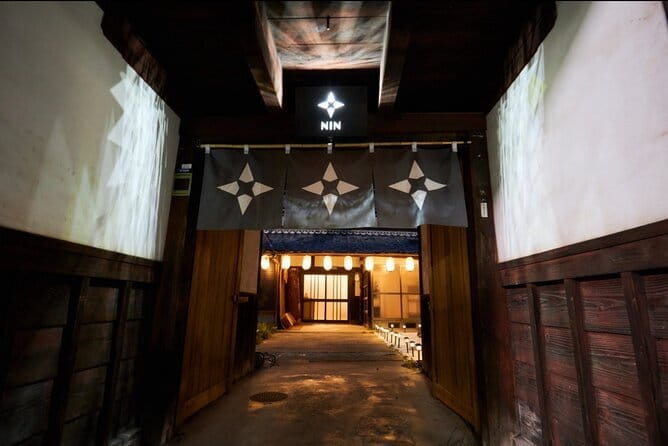
The listed meeting point is Studio Shinobi YASE, at 168-1 Yase-no-secho, Sakyo-ku, Kyoto City. The directions say it is a one-minute walk from the Yase-Hieizan Exit of the Eizan Electric Railway, and recommend coming by train. Taxis are another option.
There are two studios in Sakyo-ku, Studio NIN Yase and Studio NIN Kendo, and the team will message you before the visit to confirm which one to use. Pay close attention to that message and match the studio name and address before you leave. A wrong turn between locations could cost you valuable time before a fixed-length session.
The studio is outside central Kyoto, so allow time for the train journey and for finding the right entrance. One participant found the directions confusing after being sent to a different studio, a good reason to check the latest instructions rather than relying on an old map pin. Wear socks, the only item specifically listed as something to bring.
More Kyoto tours in Kyoto:
- PERFECT KYOTO 1-Day Bus Tour
★ 5.0 · 13,518 reviews - Kyoto: Fushimi Inari, Kinkakuji, Bamboo Grove 1 Day Bus Tour
★ 4.8 · 4,316 reviews - Kyoto: Tea Ceremony in a Traditional Tea House in Kiyomizu
★ 4.9 · 3,519 reviews
Get dressed, learn the tools and hear the plan
At arrival, you meet the instructor and change into the traditional blacksmith’s outfit provided. It is a small detail, but it helps set the mood: for a few hours, you are stepping into a working craft rather than joining a standard sightseeing activity.
Mao is described as a knife professional with more than ten years of experience. Instructors explain the tools, including hammers, tongs and grinders, and go over safety before you begin. English and Japanese instruction are available, and small groups may be offered. A small class can mean more chances to ask for help with your hammering or sharpening, though group size depends on the session.
You also get an explanation of how the knife takes shape. The workshop offers only a brief introduction to the history and techniques behind Japanese blades, rather than an extended cultural lecture. If historical context is your main reason for booking, you may wish there were more of it. If you want to spend your time working with your hands, the practical focus is a plus.
Feel the heat, then shape the steel
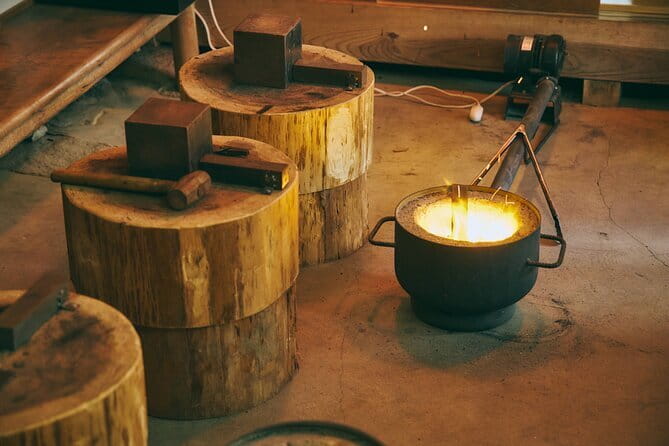
The forging begins when the raw metal goes into the furnace. It heats until it glows red, and then the instructor guides you as you hammer it into a blade shape. You learn to think about the angle, rhythm and force of each strike instead of simply hitting as hard as possible.
This is the central moment of the workshop, and the part that asks the most of you. You will repeat the movement, and the steel and furnace make the heat impossible to ignore. One useful tip: stretch before you arrive. The repeated hammering can be more tiring than it looks, especially if you have spent the day walking around Kyoto.
Safety is taken seriously because the metal can reach about 800 to 900°C. The instructor shows you how to work with the tools and stays nearby to help. Even so, this is a real workshop activity with inherent risk. The operator notes that participants are responsible in the unlikely event of an injury or accident, so listen closely, follow instructions and do not treat the tools as props.
The session is designed so beginners can take part. You are not expected to arrive with metalworking experience, and the instructor can step in when needed. That support helps the finished knife remain usable without making the work feel entirely done for you. The balance is part of the appeal: you shape the blade yourself, but you are not left to guess your way through a dangerous process.
Refine, sharpen and choose your finish
After forging, the metal is cooled and checked for shape. You then work on rough edges and prepare the blade for sharpening. The shift from heavy hammering to more controlled finishing gives you a different feel for the craft: shaping the steel is only part of the job, and a knife needs a carefully formed edge to be useful.
With guidance, you use sharpening stones and grinders to bring the edge to life. The workshop is intended to produce a functional blade, though you should not expect factory-perfect uniformity. Small variations are part of a handmade object. The important point is that the instructor helps you correct mistakes and arrive at a knife you can feel good about taking home.
The finished blade may have a traditional kurouchi appearance: a dark, rustic finish left by forging. It is not a flaw that needs to be polished away. If you prefer a bright, mirror-like blade, ask what finish is available before booking. The rustic look is part of the knife’s character, and it helps distinguish your work from a mass-produced souvenir.
Some participants have chosen between a knife with or without a handle, with one reporting a ¥5,000 extra charge for a handle. Treat that as a detail to verify, not a guaranteed current price. Ask the studio what choices are available, what is included in the $154 price and whether an add-on is payable separately.
Same city, a different side of it:
- Kyoto Geisha Walking Tour: Gion District & Hidden Gems
★ 4.7 · 3,273 reviews - Kyoto: Tea Ceremony Ju-An at Jotokuji Temple
★ 4.9 · 3,207 reviews - Kyoto: Gion Magical Night Walking Tour with Geisha Trivia
★ 4.9 · 2,393 reviews - Kyoto: 45-Minute Tea Ceremony Lesson Experience
★ 4.3 · 2,378 reviews
Take home a useful souvenir
The finished knife is about 13 to 15 cm long. Its size makes it easier to imagine using at home than a large display blade, and the compact format keeps this workshop within a few hours. A box and bag are included, so you have basic packaging for the trip home.
Before leaving, you can polish the blade, take photos and ask questions about technique, history or knife care. Photos and videos are welcome throughout the process. That is useful because you will be busy handling tools and may not want to stop at every stage to document it yourself.
A handmade knife is a personal souvenir, but it is also a sharp tool. Plan how you will pack and transport it in line with your airline and local rules; the workshop information does not specify travel or baggage requirements. For a gift, the story is part of the value: you can give someone a knife and explain that you helped forge and sharpen it in Kyoto.
Who will enjoy three hours at the forge
This is a strong choice if you like practical activities, want to learn by doing, or are looking for something different from temples and museums. It can suit solo visitors, couples and families with older teenagers. Several family groups have enjoyed making knives together, and the clear instruction makes it possible to join without prior experience.
The age information needs a little care. The activity is marked as not suitable for children under 15, while another note says children under 15 must be accompanied by a guardian. Those statements do not match neatly. If you plan to bring someone under 15, check with the provider before booking rather than assuming a guardian is enough.
It is less suitable if you have limited tolerance for heat, standing or repeated hammering. The activity is physical, and summer conditions can make a hot workshop harder. The team has provided cooling aids during hot periods, but that should not be treated as a guarantee for every session. People over 95 are also listed as not suitable.
Is the knife-making workshop worth booking?
Book it if you want to take part in a real craft, do not mind putting in some physical effort, and value a souvenir you helped create. The strongest part is the full sequence, from heating and hammering to sharpening and polishing, with instructors there to keep the work manageable and safe.
Skip it if you want a relaxed, mostly seated activity, a detailed history lesson, or a large blade made in a longer session. Before paying, confirm the assigned studio, ask about any handle surcharge and make sure you are comfortable with the safety terms. If those details suit you, this is a memorable way to spend a few hours near Kyoto, and you will leave with more than a photograph.
FAQ
How long does the knife-making experience take?
The activity is listed as three hours. The knife-making format is also described as a refined 2.5-hour session, so plan on the full three hours for your visit.
How much does it cost?
The listed price is $154 per person. A participant has reported a ¥5,000 extra charge for a knife with a handle, so confirm the current choices and any additional cost with the studio.
What size knife will I make?
The finished knife is about 13 to 15 cm long. Larger knives require more than five hours and cost over $400.
Where is the meeting point?
The listed meeting point is Studio Shinobi YASE, at 168-1 Yase-no-secho, Sakyo-ku, Kyoto City. The operator uses two studios and will message you to confirm which location to attend, so check that message before travelling.
What should I bring?
Bring socks. The workshop provides a costume, towel, water, tools, materials, a box and a bag.
Is the workshop suitable for beginners?
Yes. The instructor explains the tools and safety procedures, then guides you through forging and sharpening. No previous blacksmithing experience is listed as a requirement.
Can children take part?
The information says the activity is not suitable for children under 15, but also says children under 15 must be accompanied by a guardian. Since those instructions conflict, contact the provider before booking for anyone under 15.
Newly added in Kyoto
- Uji: Private immersion into Kyoto’s tea and reglious culture★ 5.0 · 17 reviews
- Whisk Your Own Matcha: A Zen Matcha Experience at Temple★ 3.6 · 7 reviews
- Kyoto tea town for matcha lovers★ 5.0 · 16 reviews
- Treasures of Kyoto: Gion & historical Walking Tour★ 5.0 · 6 reviews
- Uji and Wazuka Matcha Farm Half Day Private Guided Tour★ 5.0 · 21 reviews
- Kyoto Matcha Green Tea Tour★ 4.5 · 23 reviews
- Uji Tea Ceremony and UNESCO Heritage Walking Tour★ 5.0 · 20 reviews
- Utilising upcycled Matcha! Creating matcha incense (Uji, Kyoto)★ 5.0 · 6 reviews
Kyoto Tours, compared.


Fushimi Inari, Kinkakuji, Bamboo Grove 1 Day Bus Tour
Read our review →
Tea Ceremony in a Traditional Tea House in Kiyomizu
Read our review →
Kyoto Geisha Walking Tour: Gion District & Hidden Gems
Read our review →
Gion Magical Night Walking Tour with Geisha Trivia
Read our review →