Reviewed · KYOTO TOURS
Let’s make Japanese accessories with Mizuhiki
Mizuhiki looks delicate, but these twisted paper cords are light and surprisingly sturdy. In this one-hour Kyoto workshop, you’ll learn a traditional knot and use colorful cords to make an accessory or ornament, with a small Pochi bag as part of the lesson.
I like two things about the format: you get to make something with your hands, and the class connects the craft to its use in Japanese celebrations. The included matcha and sweets also give you a calm finish after concentrating on knots.
The main consideration is time. An hour is enough for a focused introduction, but your finished piece will depend on the design you choose and how quickly the knotting comes together. Materials for continuing at home are not included.
- Start with a mini Pochi bag: Choose colored paper and make a small envelope-style bag before learning the basic knot.
- Learn the abalone knot: Practice it first with a cord, then use Mizuhiki to make an accessory.
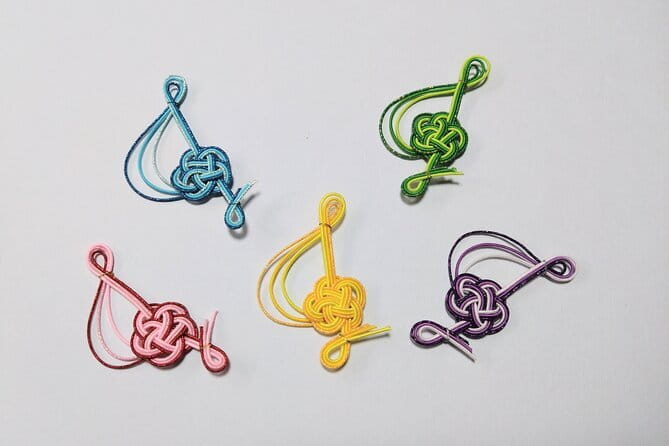
- Pick from sample designs: Options can include earrings, hair ornaments, keychains, straps, and mini baskets.
- Take a private class: Only your group participates, so the instructor can guide your work directly.
- End with matcha and sweets: Both are included, as are the materials used during the workshop.
- Plan ahead: The class averages 38 days’ advance booking, and earlier times may be available if you ask.
A paper cord with a ceremonial purpose
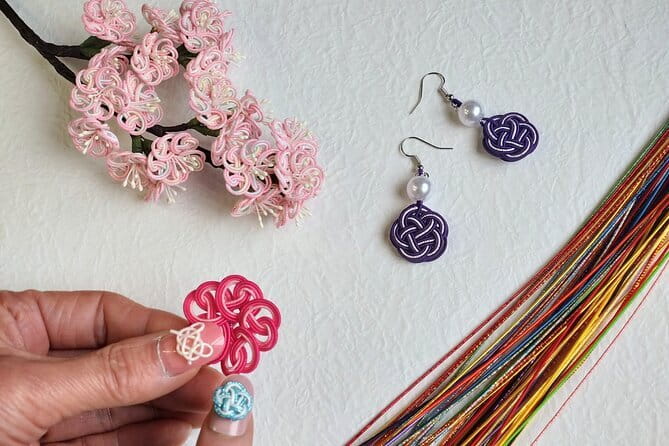
Mizuhiki is made by twisting thin paper into cord, sometimes with thread, to create a material that is both light and firm. It is used in Japanese rituals and still appears on envelopes for celebratory gifts. The knot is not just decoration: its shape and color are part of the meaning and care attached to the presentation.
That background gives this class more substance than a simple souvenir-making session. You are learning a practical craft with a place in everyday customs, then adapting it into something you can wear or take home. The workshop keeps the explanation approachable by teaching through making rather than asking you to absorb a long history lesson first.
Mizuhiki cords come in many colors, which makes the design choices part of the fun. You can combine shades to suit a small accessory, and the finished work can be a personal reminder of Kyoto rather than a shop-bought item.
Make the Pochi bag before tackling the knot
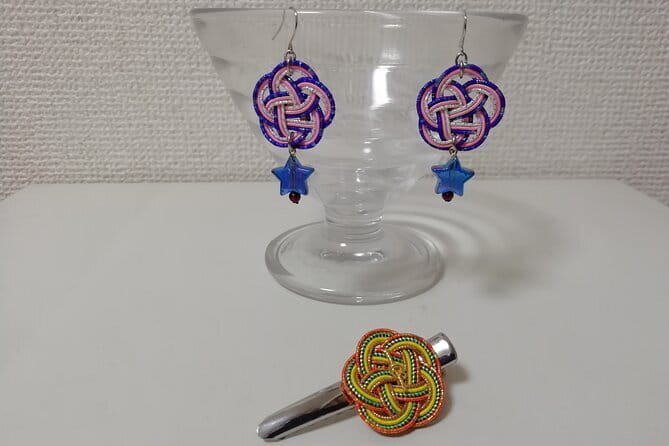
The lesson begins by choosing colored paper for a Pochi bag, a small envelope-style bag. You then tie the basic abalone knot onto it. This first step gives you a simple object to work on while you get used to the cord and the way it bends.
Next, you practice the abalone knot with a single Mizuhiki cord. That progression matters. The knot can look more complicated than it feels once someone demonstrates it slowly, but trying it first on a small bag gives you a chance to understand the movement before moving on to an accessory.
One instructor, Akemi, has guided students through several knot types, including a leaf knot and a flat plum knot, using one, two, and three cords in different colors. Those may not be part of every class, so treat them as examples of what the craft can involve, not a guaranteed checklist for your hour.
The useful thing is that the instructor works at your pace. People with little experience making things have completed accessories with patient guidance. If you are not naturally nimble with your fingers, you should still be able to follow along, though a small amount of patience will help.
More Kyoto tours in Kyoto:
- PERFECT KYOTO 1-Day Bus Tour
★ 5.0 · 13,518 reviews - Kyoto: Fushimi Inari, Kinkakuji, Bamboo Grove 1 Day Bus Tour
★ 4.8 · 4,316 reviews - Kyoto: Tea Ceremony in a Traditional Tea House in Kiyomizu
★ 4.9 · 3,519 reviews
Choose a design that fits your hour
After practicing, you select an accessory or ornament from the samples. Possible designs include strawberry straps, flower hair ornaments, cute earrings, and mini baskets. Other completed pieces have included keychains and flower earrings.
This is where it helps to be realistic about the clock. The activity lasts about an hour, including the final tea break, so the class is a short introduction rather than an open-ended studio session. A simple design may suit you if you want to leave with a finished piece; a more intricate choice may take more concentration and guidance.
You can look at the work shown under the Instagram account rakue9 before you go. That gives you a sense of the kinds of designs offered and may help you arrive with a preference. Still, the samples at the workshop are the practical guide to what you can choose on the day.
The cords are used to form the knot and shape the piece, while metal fittings may be needed for some wearable designs. The class materials are included, but Mizuhiki and fittings for making more pieces at home are not. If you hope to continue the craft after the workshop, ask what supplies you would need before you leave.
A private lesson makes the small details easier
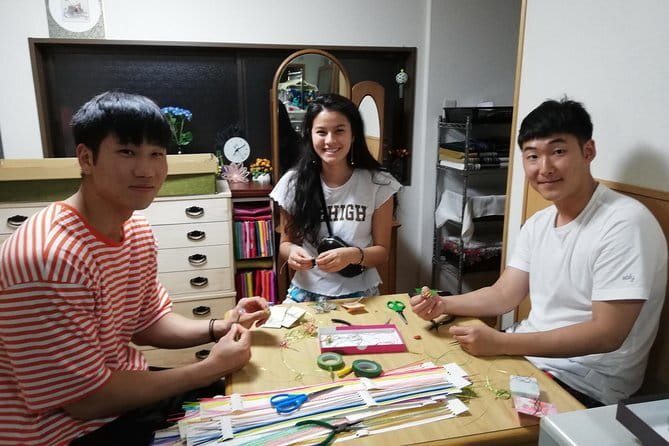
This is a private activity, so only your group takes part. That makes a difference in a craft class: you can ask for a knot to be demonstrated again, and the instructor can focus on your work rather than divide attention among unrelated groups.
The instructor is frequently described as gentle, patient, and encouraging. Akemi’s teaching has included breaking knots down into stages and moving from one cord to several. That kind of step-by-step help is especially useful when a design looks intricate at first glance.
The setting is described as small and welcoming, rather than a large production-style class. The workshop is at RakueJapan, in the Nomura Building, second floor, at 255 Shijo Horikawacho in Kyoto’s Shimogyo Ward. It is near public transportation, and the activity ends back at the meeting point.
There is also a note that kimono rental is available at the shop. That may interest you if you are planning a day in traditional dress, but the class itself does not include a kimono rental. Check directly with the provider if you want to coordinate the two.
Matcha and sweets bring the class to a gentle close
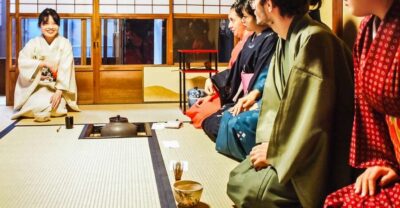
Once the making is done, you take a break with matcha and sweets. They are included in the price, so this is not an extra purchase or a stop you need to arrange elsewhere. It also gives your hands a rest after concentrating on the knotting.
The tea is a small part of the hour, but it completes the pace of the experience. You begin with a traditional craft, focus on a design, then sit down for a quiet pause. If your Kyoto itinerary is packed with temples and long walks, this slower ending may be welcome.
Do not expect a full tea ceremony. The activity promises matcha and sweets as a refreshment, not a formal ceremony or an extended cultural demonstration. That distinction helps set the right expectations.
Same city, a different side of it:
- Kyoto Geisha Walking Tour: Gion District & Hidden Gems
★ 4.7 · 3,273 reviews - Kyoto: Tea Ceremony Ju-An at Jotokuji Temple
★ 4.9 · 3,207 reviews - Kyoto: Gion Magical Night Walking Tour with Geisha Trivia
★ 4.9 · 2,393 reviews - Kyoto: 45-Minute Tea Ceremony Lesson Experience
★ 4.3 · 2,378 reviews
What $19.60 gets you
At $19.60 per person, the price includes the workshop materials and the matcha and sweets. For a private, instructor-led craft lesson, that is a fair value, especially if you want to learn a technique rather than simply buy a finished accessory.
The value depends on what you want from the hour. If you enjoy making things and want an introduction to a traditional Japanese craft, the combination of instruction, materials, and a completed piece is appealing. If your priority is a long, in-depth class or a large take-home project, this short session may feel limited.
The class is also a personal alternative to buying a Kyoto souvenir. You choose the colors and make the knot yourself, so the finished item carries a memory of the activity as well as the city. Just remember that the price does not cover Mizuhiki cords or metal fittings for making additional pieces at home.
The activity averages 38 days’ advance booking. That is worth keeping in mind if you have a fixed Kyoto schedule. The provider says to get in touch as soon as possible if you want an earlier time, since additional reservation slots may be opened.
Who will enjoy this Kyoto craft class
I would recommend this workshop if you like hands-on activities, small crafts, or souvenirs with a story behind them. It suits couples, friends, and solo visitors who want a quiet break from sightseeing. Since it is private, your group can work together without sharing the class with strangers.
It can also work well for beginners. The instructor demonstrates the basic knot, and the class moves from practice to a chosen design. You do not need to arrive with a craft background, though you should be comfortable spending time on a small, detail-focused task.
It may be less suitable if you want a long class, a broad survey of Japanese crafts, or a guaranteed choice of advanced designs. The session is about an hour, and the exact piece you complete depends on the available samples and your pace. If a particular design matters to you, check with RakueJapan before booking.
Should you book the Mizuhiki workshop?
Book this class if you want a manageable, personal introduction to Mizuhiki and would enjoy making a small accessory with an instructor’s help. The cultural context, private format, included materials, and matcha break make the $19.60 price easy to justify for craft-minded visitors.
Skip it if you want a long, technical lesson or expect to leave with supplies for making more pieces at home. For a one-hour pause in Kyoto that pairs traditional knotting with a handmade keepsake, though, this is a thoughtful choice. It is also a good way to spend an hour doing something more personal than browsing another souvenir shelf.
FAQ
How long does the Mizuhiki workshop last?
The activity lasts about one hour.
How much does the class cost?
The listed price is $19.60 per person.
Is the workshop private?
Yes. Only your group participates.
What is included in the price?
Workshop materials, matcha, and sweets are included.
What can I make during the class?
You choose from sample designs. Examples include earrings, hair ornaments, straps, keychains, and mini baskets.
Do I learn a Mizuhiki knot?
Yes. The lesson includes practicing the basic abalone knot before using Mizuhiki to make an accessory.
Are supplies for making more accessories at home included?
No. Mizuhiki for non-gift items and metal fittings for making accessories at home are not included.
Where does the workshop meet?
It meets at RakueJapan, on the second floor of the Nomura Building at 255 Shijo Horikawacho, Shimogyo Ward, Kyoto. The activity ends at the meeting point.
Can I cancel for a refund?
You can cancel at least 24 hours before the experience for a full refund. Cancellations or changes made less than 24 hours before the start time are not accepted for a refund.
Newly added in Kyoto
- Uji: Private immersion into Kyoto’s tea and reglious culture★ 5.0 · 17 reviews
- Whisk Your Own Matcha: A Zen Matcha Experience at Temple★ 3.6 · 7 reviews
- Kyoto tea town for matcha lovers★ 5.0 · 16 reviews
- Treasures of Kyoto: Gion & historical Walking Tour★ 5.0 · 6 reviews
- Kyoto Matcha Green Tea Tour★ 4.5 · 23 reviews
- Uji and Wazuka Matcha Farm Half Day Private Guided Tour★ 5.0 · 21 reviews
- Uji Tea Ceremony and UNESCO Heritage Walking Tour★ 5.0 · 20 reviews
- Utilising upcycled Matcha! Creating matcha incense (Uji, Kyoto)★ 5.0 · 6 reviews
Kyoto Tours, compared.

Fushimi Inari, Kinkakuji, Bamboo Grove 1 Day Bus Tour
Read our review →
Tea Ceremony in a Traditional Tea House in Kiyomizu
Read our review →
Kyoto Geisha Walking Tour: Gion District & Hidden Gems
Read our review →
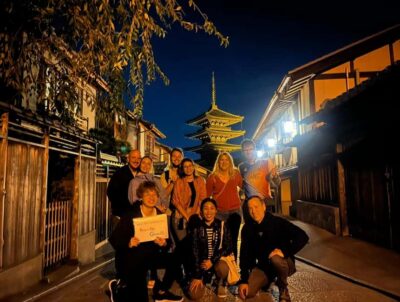
Gion Magical Night Walking Tour with Geisha Trivia
Read our review →