
Reviewed · KYOTO TEA CEREMONIES
Kyoto: Tea Ceremony with Maiko
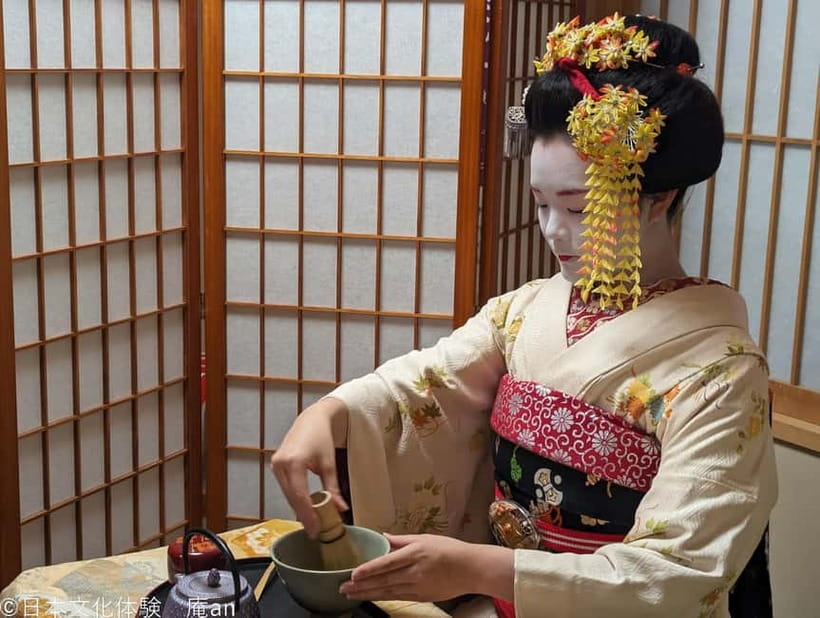
A maiko showing you how to whisk matcha, then answering your questions about her life, makes this a more personal encounter than a quick photo stop. I like two things in particular: you get to make your own tea, and the Q&A gives you a chance to learn about the work behind the elegant appearance. At $28, it is also a compact way to add a Kyoto-specific activity to a busy day.
There is one practical caveat: the venue is in a modern building, not a traditional tea house, and the stairs may be a concern if you have mobility limits. The session is short, too, so come ready to take part and ask questions rather than expecting a long cultural demonstration.
What makes this short Kyoto session worthwhile
- You make the matcha yourself: The maiko demonstrates the process before you prepare a cup.
- Two ohigashi sweets come with the tea: These are dry-style Japanese sweets, served alongside the matcha.
- The Q&A brings the maiko’s working life into view: You can ask her questions directly, with English translation offered as much as possible if requested.
- You get a close-up photo opportunity: The session includes a commemorative photo beside the maiko.
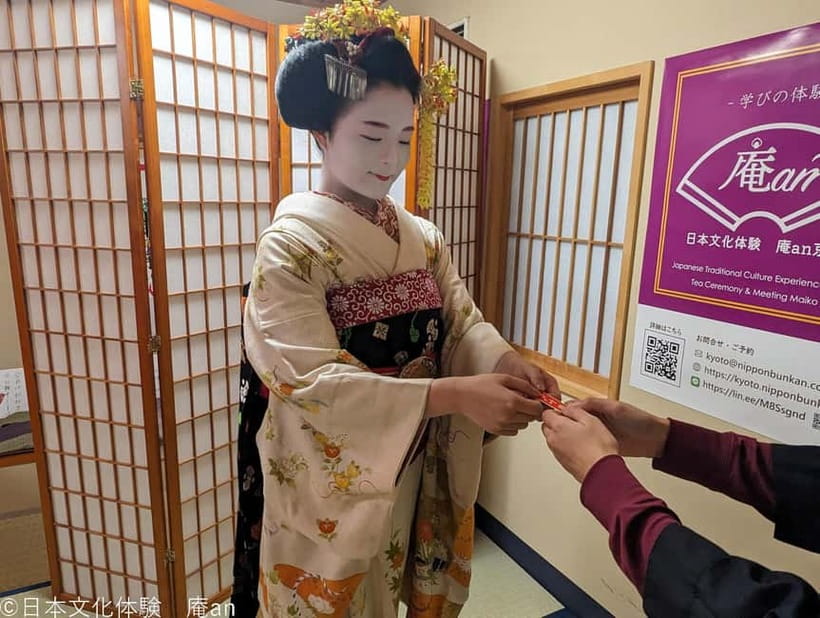
- A Senjafuda is part of the farewell: The maiko gives you this small lucky charm as a keepsake.
- The venue is near Gojo Station, not a traditional house: It is a practical location, but set expectations accordingly.
Meeting a maiko without turning her into a street-side photo
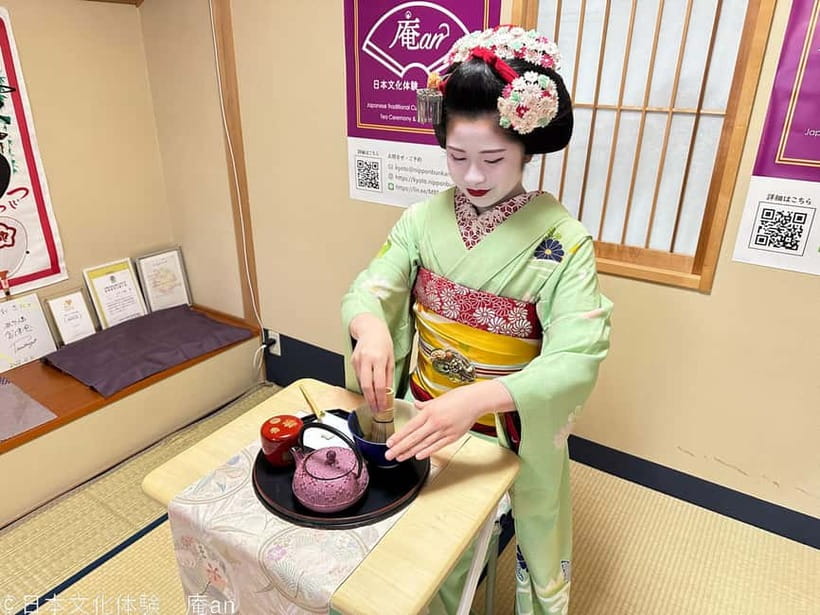
Maiko are apprentice geiko, and their public appearance can attract attention in Kyoto. This session offers a more considerate way to meet one: you spend time with her in an organized setting, listen to her explain the tea, and ask questions rather than trying to catch a hurried glimpse in the street.
The format is simple and accessible. You do not need prior tea ceremony experience, special clothes, or preparation. The maiko demonstrates how to make matcha and explains what to do; then you make your own cup. The aim is not to master a formal tea ceremony in half an hour. It is to get a hands-on introduction and a chance to speak with someone whose daily life is tied to a distinctive Kyoto tradition.
Depending on the date, the host may be a geiko instead of a maiko. Both are part of Kyoto’s traditional performing arts world, but the distinction matters if meeting a maiko specifically is your main reason for booking. The host is not guaranteed, so check the arrangement if that detail is essential to you.
One session has been led by Masaya-san, whose clear answers and confidence helped make the ceremony easy to follow. The host can change, so think of her name as an example rather than a promise. The organizer, B.B.Advisors Inc. AN KYOTO, also has staff on hand to explain how the session works.
More geisha and maiko experiences in Kyoto:
- Kyoto Geisha Walking Tour: Gion District & Hidden Gems
★ 4.7 · 3,273 reviews - Kyoto: Gion Magical Night Walking Tour with Geisha Trivia
★ 4.9 · 2,393 reviews - Kyoto: Gion Geisha District Walking Tour – Stories of Geisha
★ 4.7 · 2,187 reviews
Making matcha, not just watching someone else
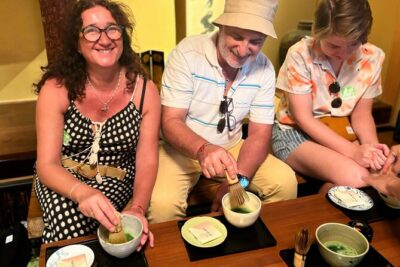
The tea portion is the heart of the activity. First, the maiko shows you how to prepare matcha and talks you through the steps. Then you make your own tea. That small act matters: it shifts the experience from a performance you observe to a custom you try for yourself.
Your matcha comes with two pieces of ohigashi, a dry-style Japanese sweet. These are not the soft, filled sweets some people picture when they hear wagashi. The pairing gives you a taste of a different kind of Japanese confection, while keeping the focus on the tea.
The session is brief, so it is best approached as an introduction rather than a full study of tea ceremony. You will not spend hours on formal etiquette or the history of every utensil. Instead, you get a demonstration, a chance to make tea, and a relaxed setting in which to ask questions. For a first encounter, that balance is useful: there is enough activity to hold your attention, without asking you to arrive with specialist knowledge.
If you have never prepared matcha, do not worry about getting every movement perfect. The point is to follow the demonstration and take part. The staff are there to guide the flow, and the activity is presented as suitable for people without special preparation.
Asking about life as a maiko
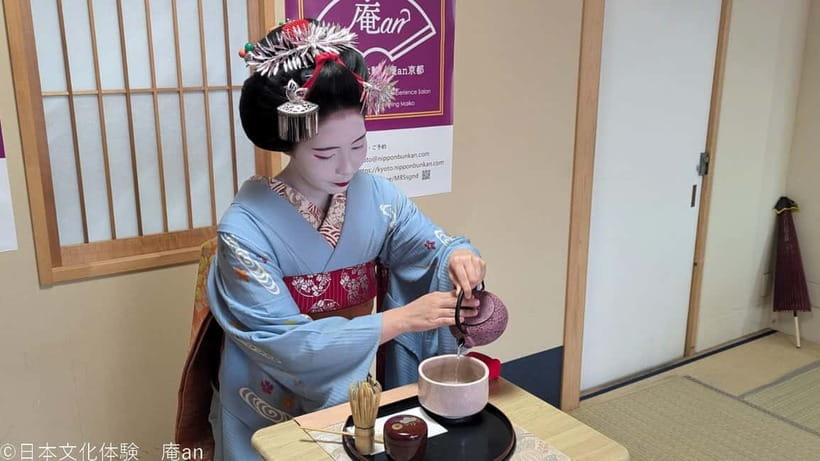
The Q&A is likely to be the most revealing part for anyone curious about the person behind the kimono and hairstyle. You can ask the maiko directly about her daily life and her path toward becoming a geiko. That personal exchange helps put the ceremony in context: you are not only watching a tradition, but hearing from someone who lives and works within it.
The main language is Japanese. English translation is offered as much as possible, and you should contact the organizer in advance if you would like it. Translation may affect how freely a conversation flows, so it is sensible to prepare a few questions rather than rely on an extended, spontaneous discussion in English.
Good questions are the ones that invite explanation, such as what a typical working day involves or how a maiko’s training changes over time. The session is not a lecture with a fixed list of answers. Your chance to ask questions is a central feature, so take advantage of it respectfully and keep in mind that the maiko is working.
The photo and the Senjafuda keepsake
After the tea and Q&A, you can take a commemorative photo beside the maiko. This is a close-up opportunity in a controlled setting, which is a more respectful alternative to trying to photograph someone while she is going about her day. The photo is included in the activity.
As a final gesture, the maiko gives you a Senjafuda, a lucky charm. It is a small memento, not a major souvenir, but it adds a personal note to a compact program. The maiko then leaves, and you have time to depart the room by the 45-minute mark.
Keep your expectations in proportion. The listed program centers on tea, sweets, questions, a photo, and the charm. Some occasions may include additional elements, but they are not part of the standard schedule, so do not book expecting a dance, a game, or other extras.
More tea ceremonies in Kyoto:
- Kyoto: Tea Ceremony in a Traditional Tea House in Kiyomizu
★ 4.9 · 3,519 reviews - Kyoto: Tea Ceremony Ju-An at Jotokuji Temple
★ 4.9 · 3,207 reviews - Kyoto: 45-Minute Tea Ceremony Lesson Experience
★ 4.3 · 2,378 reviews - World Heritage Kyoto & Nara Uji Authentic Matcha Experience
★ 5.0 · 1,573 reviews
A useful location, with a few things to plan around
The meeting point is a one-minute walk from Exit 1 of Gojo Station on the Karasuma subway line. The entrance faces Gojo-dori, a straightforward location if you are already using the subway. One useful landmark is the Carnival supermarket: the venue has been described as being above it, with stairs leading up.
The setting is inside a building rather than an ochaya or traditional Japanese house. That may disappoint you if you are picturing tatami rooms and old wooden architecture. On the other hand, the venue is described as relaxed, and the practical location makes this a convenient activity to fit between other plans.
There is no elevator, and you must use the stairs to reach the venue. Arrive on time: the activity cannot be held for late arrivals, and latecomers are not entitled to a refund. Allow a little extra time to find the entrance, especially if you are unfamiliar with Gojo Station or the surrounding streets.
The session runs for about 45 minutes overall. The main program is scheduled to finish at around 30 minutes, followed by the photo and Senjafuda, with room departure at 45 minutes. The shorter format works well if your Kyoto schedule is tight, though it leaves little room for a late start or a long conversation.
What $28 buys, and who gets the best value
At $28 per person, the price covers the tea ceremony with a maiko, matcha, two ohigashi sweets, a photo opportunity, and the Senjafuda gift. The value is not in the amount of food or the length of the program. You are paying for a rare, organized chance to meet a maiko, try making matcha, and ask about her life in one short visit.
This is a good fit if you have limited time in Kyoto, want an activity that is more interactive than a staged demonstration, or are curious about the maiko tradition but do not want to pursue a longer or more formal experience. It can also suit families, as children under two may sit on a parent’s lap for free. A child who needs their own seat pays the same fee as one participant.
It is less suited to you if your main goal is a traditional-house setting, a full-length tea ceremony, or guaranteed English conversation. The venue is modern, the session is brief, and the main language is Japanese. Those are not minor footnotes; they shape what you will actually get.
Booking changes and cancellations also deserve a quick check before you commit. You can cancel up to eight days in advance for a full refund. Changes to the date or time within seven days of booking incur a fee, and cancellation charges may apply depending on the policy. Travel costs to the venue are not reimbursed if you cancel.
Should you book the maiko tea ceremony?
Book it if you want a compact, hands-on Kyoto encounter that combines matcha with a personal conversation. The best parts are making the tea yourself, asking the maiko about her life, and getting a photo and Senjafuda without treating a working performer as a street attraction.
Skip it if you are looking for an old Kyoto teahouse, a long formal ceremony, or a guaranteed English-language presentation. If the stairs are difficult for you, the lack of an elevator is another reason to reconsider. For everyone else, this is a focused way to spend 45 minutes and get closer to one of Kyoto’s best-known traditions.
FAQ
How long does the activity take?
Plan for 45 minutes in total. The main program is scheduled to finish at about 30 minutes, followed by the photo and Senjafuda presentation before you leave the room.
Where is the meeting point?
It is a one-minute walk from Exit 1 of Gojo Station on the Karasuma subway line. The entrance faces Gojo-dori.
Will a maiko definitely host the session?
Not always. Depending on the date, the host may be a maiko or a geiko.
Is the session in English?
The main language is Japanese. English translation is offered as much as possible. Contact the organizer if you would like translation.
What is included in the price?
The fee includes the tea ceremony with a maiko, matcha, two dry-style Japanese sweets, a photo opportunity, and a Senjafuda lucky charm.
Is the venue a traditional Japanese house?
No. It is in a building and is not an ochaya or traditional Japanese house. The venue is described as relaxed, with friendly staff.
Is there an elevator?
No. You will need to use the stairs to reach the venue.
Can I cancel for a full refund?
You can cancel up to eight days in advance for a full refund. Fees may apply for cancellations or changes closer to the activity, so check the cancellation terms before booking.
Newly added in Kyoto
- Uji: Private immersion into Kyoto’s tea and reglious culture★ 5.0 · 17 reviews
- Whisk Your Own Matcha: A Zen Matcha Experience at Temple★ 3.6 · 7 reviews
- Kyoto tea town for matcha lovers★ 5.0 · 16 reviews
- Treasures of Kyoto: Gion & historical Walking Tour★ 5.0 · 6 reviews
- Kyoto Matcha Green Tea Tour★ 4.5 · 23 reviews
- Uji and Wazuka Matcha Farm Half Day Private Guided Tour★ 5.0 · 21 reviews
- Uji Tea Ceremony and UNESCO Heritage Walking Tour★ 5.0 · 20 reviews
- Utilising upcycled Matcha! Creating matcha incense (Uji, Kyoto)★ 5.0 · 6 reviews
Kyoto Tea Ceremonies, compared.

Tea Ceremony in a Traditional Tea House in Kiyomizu
Read our review →

World Heritage Kyoto & Nara Uji Authentic Matcha Experience
Read our review →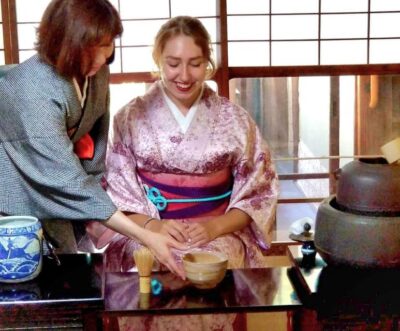

Arashiyama Bamboo Forest, Monkeys, Matcha & Temple Tour
Read our review →
Tea Museum Tickets and Matcha Grinding Experience
Read our review →Browse the lists this tour appears in