
Reviewed · KYOTO TEA CEREMONIES
Kyoto: Tea Ceremony with Maiko Premium
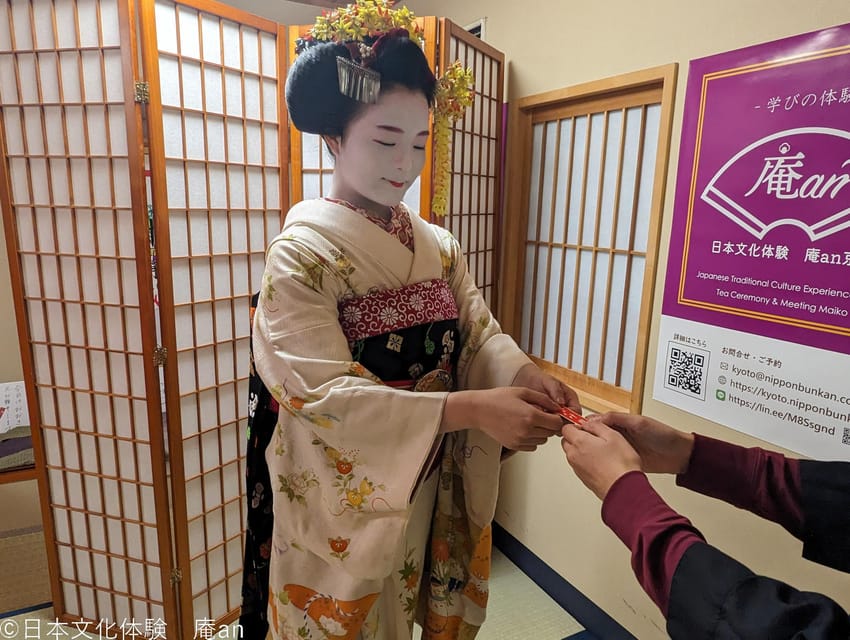
Kyoto’s Maiko culture can feel like a world glimpsed from a passing taxi. This 90-minute program gives you a closer look: you make matcha with a Maiko, ask about her life, watch two dances, and take a photo together. It is a lively introduction, not a formal tea ceremony in a historic tea house.
I like two things especially: you get to talk with the performer, not just watch from a distance, and the dances and game give the session a playful finish. One thing to keep in mind: the venue is a room in a modern building, with tables and stools, so the setting is less traditional than the kimono and ceremony might lead you to expect.
At a glance
- Meet a Maiko or Geiko: The performer may vary by date, and a Geiko may take the Maiko’s place.
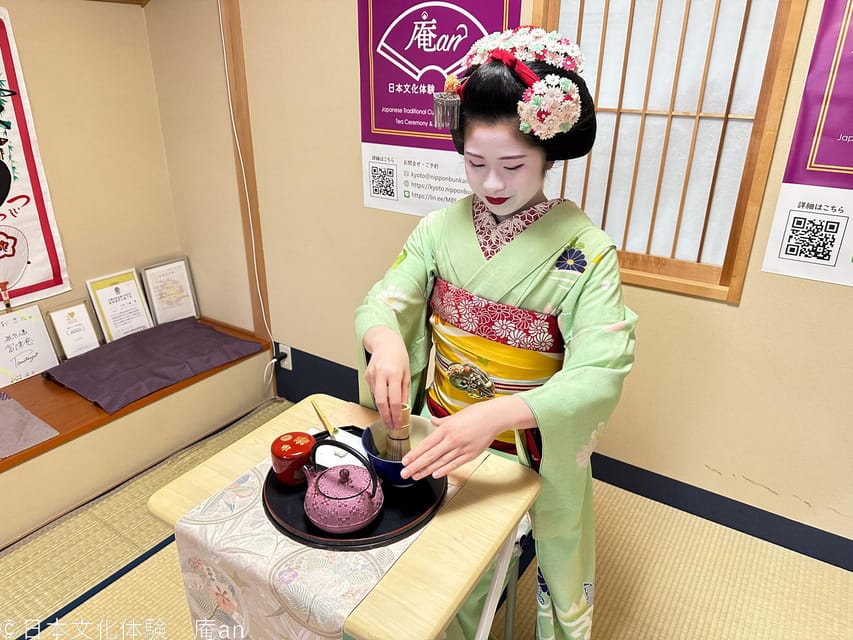
- Make your own matcha: The tea demonstration includes two dried Japanese sweets.
- Ask questions directly: The Q&A offers a chance to hear about the performer’s life and traditions.
- See two dances, then play a game: Both are part of the Premium program.
- Take a photo and receive a Senjyafuda: You get a commemorative picture opportunity and a small lucky charm.
- Know the setting: The venue is near Gojo Station, in a building without an elevator.
A close-up introduction to Maiko culture
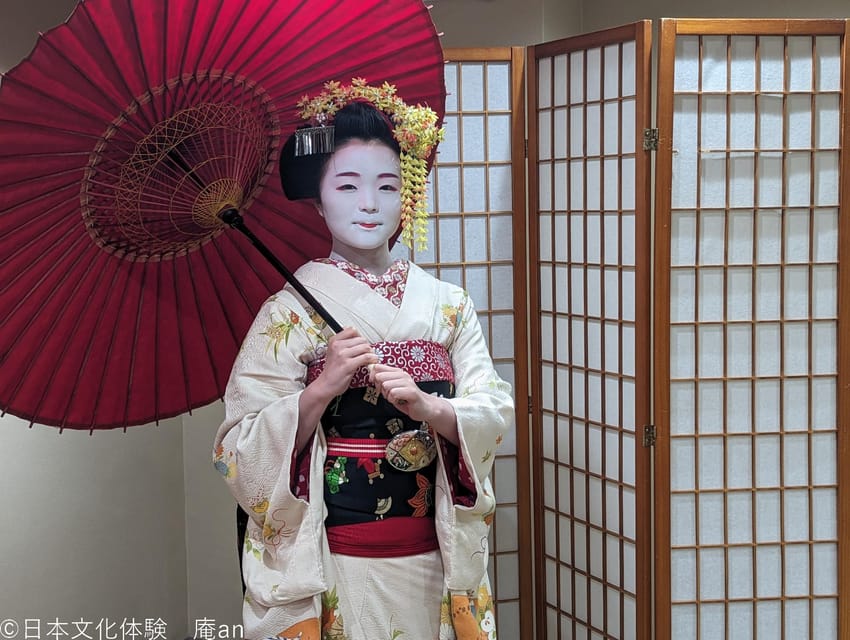
This experience combines several parts of a Maiko’s public role in one compact visit. You see her in formal dress, learn a little about her life, try matcha preparation, and watch her perform. The format makes cultural traditions easier to approach than a performance alone, because there is time to ask questions and join in.
A Maiko is part of a living tradition, with distinctive clothing, hairstyles, and daily routines. The program focuses on meeting the person behind that public image. You can ask about her training and life, then see the grace and control that go into her dances. The questions and answers are often a highlight, especially if you are curious about the realities of the work rather than only the costume.
The performer may be a Geiko instead of a Maiko. The program describes this as dependent on the situation, so book for the experience of meeting and learning from a Kyoto performer, rather than assuming a particular person or title is guaranteed.
More geisha and maiko experiences in Kyoto:
- Kyoto Geisha Walking Tour: Gion District & Hidden Gems
★ 4.7 · 3,273 reviews - Kyoto: Gion Magical Night Walking Tour with Geisha Trivia
★ 4.9 · 2,393 reviews - Kyoto: Gion Geisha District Walking Tour – Stories of Geisha
★ 4.7 · 2,187 reviews
What the 90 minutes feel like
The program starts with a greeting, then moves into the tea ceremony, Q&A, photos, a dance performance, and a game. The main activities are scheduled to wrap up at about 75 minutes, followed by time to chat before the room departure at 90 minutes. One attendee found the program closer to 70 minutes, so the full hour and a half may include time beyond the core presentation.
That matters if you are fitting this between other Kyoto plans. Allow the full 90 minutes and avoid scheduling a tight connection right afterward. The performer’s departure is part of the timing, and the session is not held for late arrivals.
The group format is friendly and interactive, but it is not a private audience. You share the Q&A, performances, and game with the other people in the room. Some sessions may also take place alongside people having lunch or dinner, so the atmosphere can vary.
Making matcha, one bowl at a time
The tea portion is hands-on. The Maiko shows you how to make matcha and explains the steps, then you prepare your own tea. Two dried Japanese sweets are served with it, giving you a simple taste of the customary pairing.
Think of this as an introduction rather than an elaborate, highly formal tea ceremony. The room has tables and stools, not tatami, and the tea-making is basic. That makes the activity approachable if you have never handled matcha, but it may disappoint if you are specifically seeking a traditional tea-house setting or a detailed lesson in tea ceremony etiquette.
I like that you are asked to make the tea yourself. It gives your hands something to do and turns a demonstration into a small shared activity. Matcha can taste strong and earthy if it is new to you; the sweets offer a contrasting bite.
The Q&A brings the tradition into focus
After tea, you can ask the Maiko questions about her life and traditions. This is the part that turns a brief performance into a more personal introduction. You are not simply studying the kimono and hairstyle from across the room; you can hear about the person’s path and routine directly.
Questions about training and daily life are a natural fit. One visitor learned that completing training takes five years, though details can depend on the person and circumstances. Keep your questions respectful and open-ended. The performer is at work, and a thoughtful question is more likely to lead to a useful exchange than a demand for private details.
The instructor language is listed as Japanese, with English translation provided as much as possible. If you want translation, contact the operator in advance. The experience can still be enjoyable without fluent Japanese, but the depth of the Q&A depends in part on how much interpretation is available that day.
More tea ceremonies in Kyoto:
- Kyoto: Tea Ceremony in a Traditional Tea House in Kiyomizu
★ 4.9 · 3,519 reviews - Kyoto: Tea Ceremony Ju-An at Jotokuji Temple
★ 4.9 · 3,207 reviews - Kyoto: 45-Minute Tea Ceremony Lesson Experience
★ 4.3 · 2,378 reviews - World Heritage Kyoto & Nara Uji Authentic Matcha Experience
★ 5.0 · 1,573 reviews
Two dances, then a game
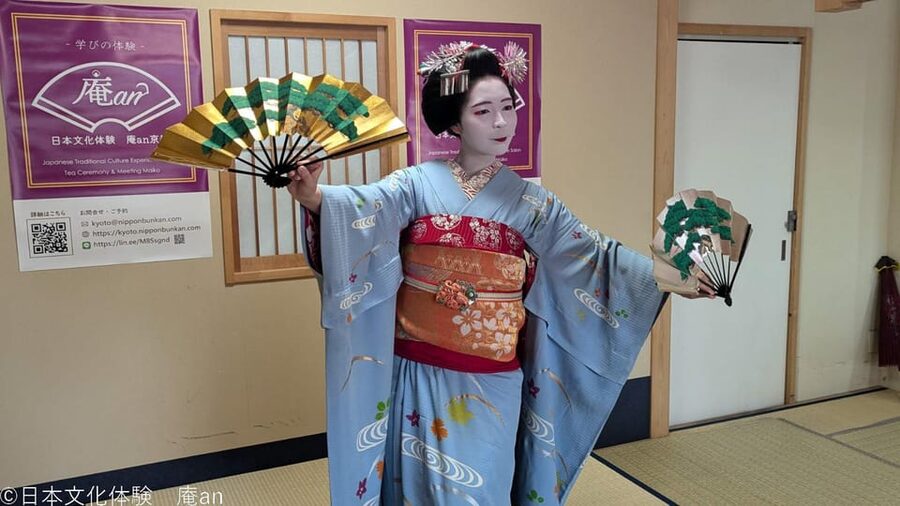
The dance performance is a visual highlight. You watch two traditional dances, described as expressing themes such as the seasons, love stories, or everyday life. The measured movements and formal presence offer a contrast to the relaxed tea and conversation.
You can take photos and videos during the presentation, but be considerate of the people around you and follow any instructions from the host. The room’s plain backdrop is a practical drawback for pictures. Some attendees have found company advertising and a QR code visible behind the performer, which can intrude on an otherwise striking image. If the background matters to you, keep that in mind when deciding how much the photo opportunity is worth.
The game brings the group back into the action. Volunteers can take part, while everyone else can watch, clap, and cheer. It is simple, sociable entertainment rather than a lesson in a complex traditional game. Families may find this is the part that keeps younger children engaged, while adults get a relaxed way to interact with the Maiko.
Photos and the Senjyafuda keepsake
The program includes a chance to take a commemorative photo beside the Maiko, plus a Senjyafuda charm presented as a special gift. The close-up picture is a tangible reminder of the meeting, especially if you have seen Maiko only at a distance elsewhere in Kyoto.
Set your expectations for the room, not just the subject of the photo. The venue is functional, and the background may include advertising. You are paying for access to the performer and the program, not a carefully staged portrait in a traditional house. If the image is important to you, take a moment to frame it thoughtfully and check the host’s guidance on when photos are allowed.
What the venue is, and what it is not
The meeting point is a one-minute walk from Exit 1 of Gojo Station on the Subway Karasuma Line. The entrance faces Gojo-dori, the main street. The venue is in a building, not an ochaya or a traditional Japanese home, and the room has been described as having tables and stools with a plain wall behind the performer.
That modern setting is the clearest trade-off. The experience offers direct interaction and a fuller program than a short stage show, but the surroundings do not recreate an old Kyoto tea room. If atmosphere and architecture are your top priorities, you may want a different activity. If you value conversation, dance, and participation, the room is a workable backdrop.
There is no elevator, and you need to use the stairs to reach the venue. Plan accordingly if stairs are a concern. Arriving about 15 minutes early is a useful idea: one attendee suggested it as a way to see the Maiko arrive, though this is not guaranteed and should not be treated as part of the scheduled program.
Is $50 a fair price?
At about $50 per person, the value comes from combining several activities in one booking: matcha preparation, two sweets, a direct Q&A, two dances, a group game, a photo opportunity, a Senjyafuda gift, and included snacks and a drink. The format saves you from trying to arrange separate cultural activities, and the chance to ask questions adds something a performance ticket alone cannot.
The price makes most sense if you want the full Premium program. The dance and game are central parts of what makes this version varied, and they are repeatedly singled out as enjoyable elements. If you only want to watch a dance or learn the basic steps of making matcha, a shorter or simpler activity may suit you better.
There are optional paid seats: SS, the first row, costs 3,300 yen; S2, the second row, costs 2,200 yen; and S3, the third row, costs 1,100 yen. Check what seat is included in your booking before paying extra. Other drinks may be available for purchase at the venue, so the included drink and any additional beverage choices are worth distinguishing.
Who should book this experience?
I would recommend it to you if you are curious about Maiko culture but want more than a performance from a distance. The mix of explanation, conversation, tea, dance, and play suits a first visit to Kyoto, a family outing, or anyone with a particular interest in traditional performing arts.
Children can enjoy it too. Children under two are free if seated on a parent’s lap, but a seat or meal for a child requires the same fee as one person. Children aged two and older should be booked according to the operator’s pricing. The activities are varied enough to hold a child’s attention better than a long lecture, though the Q&A and tea portion may be quieter.
It is less suited to you if you expect a private, highly formal ceremony, a historic room, or a guaranteed English-language conversation. The experience is a group event, and translation is provided as much as possible rather than promised in full. Be ready for a modern venue and a program whose atmosphere depends on the group.
Practical details before you go
The activity lasts 90 minutes, with starting times depending on availability. The operation hours are 10:00 to 17:00; reservations received after 17:00 are processed the next day. Contact the operator if you need English translation or have a question about a booking.
Arrive on time. The event will not be held to accommodate delays, and travel costs are not reimbursed if you miss it or the booking is cancelled. Cancellation terms allow a full refund if you cancel at least eight days in advance; fees apply after that point, and changing a reservation after a cancellation fee has been incurred may also involve a charge. Check the full terms before confirming.
Should you book?
Book this if you want a friendly, participatory introduction to Maiko culture and value the chance to ask questions as much as the performance. The combination of matcha, two dances, a game, photos, and a keepsake makes the $50 price reasonable for a packed 90-minute visit.
Skip it if your main goal is a formal tea ceremony in a historic Japanese room, or if you need guaranteed English interpretation. The setting is plain, but the encounter itself offers the substance: a chance to hear, watch, and interact with a Kyoto performer in one well-paced session.
FAQ
How long does the experience last?
The scheduled duration is 90 minutes. The main activities are set to finish at about 75 minutes, followed by chatting time and the performer’s departure.
Is the performer always a Maiko?
No. Depending on the situation, a Geiko may be invited instead of a Maiko.
What is included in the tea portion?
You watch the Maiko demonstrate matcha preparation, make your own matcha, and receive two dried Japanese sweets.
Can I ask the Maiko questions?
Yes. The program includes a Q&A session where you can ask about her life and traditions.
Are dances and a game included?
Yes. The Premium program includes two traditional dances and an interactive game with the Maiko.
Can I take a photo with the Maiko?
Yes. The program includes a chance to take a commemorative photo beside her.
Where is the meeting point?
It is a one-minute walk from Exit 1 of Gojo Station on the Subway Karasuma Line. The entrance faces Gojo-dori.
Is the venue a traditional tea house?
No. It is in a building, not an ochaya or a traditional Japanese house. There is no elevator, so you need to use the stairs.
What is the cancellation policy?
You can cancel up to eight days in advance for a full refund. Cancellation fees apply after that, so check the full policy before booking.
Newly added in Kyoto
- Uji: Private immersion into Kyoto’s tea and reglious culture★ 5.0 · 17 reviews
- Whisk Your Own Matcha: A Zen Matcha Experience at Temple★ 3.6 · 7 reviews
- Kyoto tea town for matcha lovers★ 5.0 · 16 reviews
- Treasures of Kyoto: Gion & historical Walking Tour★ 5.0 · 6 reviews
- Kyoto Matcha Green Tea Tour★ 4.5 · 23 reviews
- Uji and Wazuka Matcha Farm Half Day Private Guided Tour★ 5.0 · 21 reviews
- Uji Tea Ceremony and UNESCO Heritage Walking Tour★ 5.0 · 20 reviews
- Utilising upcycled Matcha! Creating matcha incense (Uji, Kyoto)★ 5.0 · 6 reviews
Kyoto Tea Ceremonies, compared.

Tea Ceremony in a Traditional Tea House in Kiyomizu
Read our review →

World Heritage Kyoto & Nara Uji Authentic Matcha Experience
Read our review →

Arashiyama Bamboo Forest, Monkeys, Matcha & Temple Tour
Read our review →
Tea Museum Tickets and Matcha Grinding Experience
Read our review →Browse the lists this tour appears in