
Reviewed · KYOTO TEMPLE & SHRINE TOURS
Nara World Heritage PRIVATE TOUR
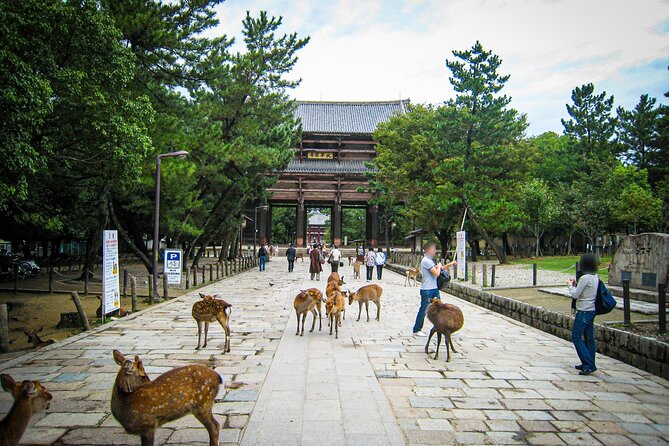
Nara’s deer wander freely among temples and visitors, but the city is more than a place to feed them. This private walking tour links the deer park with Todai-ji’s giant Buddha and Kōfuku-ji’s famous pagoda, giving you a useful introduction to Nara in about three to four hours.
I like two things in particular: your own guide can make the temples easier to understand, and the price includes admission to the temples and shrines on the route, plus a packet of crackers for feeding a deer. Guides George and Kimu, also called Kim, have been praised for their local insight and care with families.
The main consideration is that this is a walking tour in an exposed, often busy park. Nara’s summer heat can be severe, and the guiding experience may depend on how well your guide engages with your group. If you want a flexible, conversational visit, tell the guide what interests you early on.
At a glance: the useful details

- A private group, not a shared walk: The tour is for your party only, which gives you a chance to ask questions and set a pace that suits your group.
- A focused route through major sights: The planned stops include Todai-ji, Nara Park, Ukimido Pavilion, and Kōfuku-ji.
- Temple admission is included: You do not need to budget separately for entry to the temples and shrines visited on the tour.
- Deer crackers are part of the experience: One packet is included. Any extra food or drinks you buy along the way are not.
- Plan on about three to four hours outdoors: The listed stop times add up to a little over three hours, with time also needed to walk between locations.
- Start near Todai-ji and finish near Kintetsu-Nara Station: The end point is a guide, not a fixed requirement, since the group can disperse somewhere else that suits its onward plans.
Todai-ji makes a strong first stop
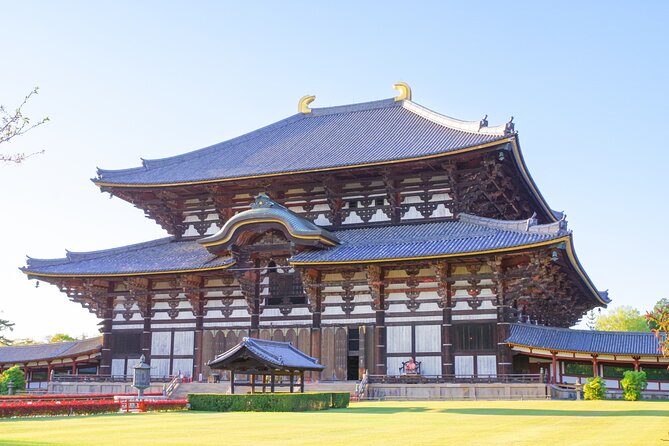
The tour begins at the Todai-ji Museum, inside the Todai-ji complex. It is a practical starting point for a visit centered on the temple, though the museum stop itself is listed as about ten minutes. Think of it as the start of your historical orientation, not a long museum visit.
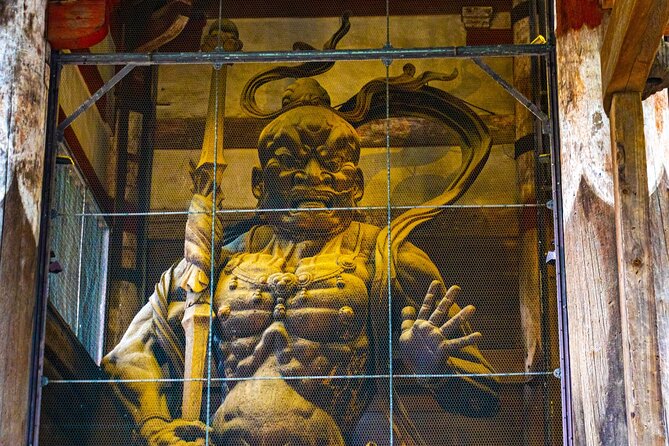
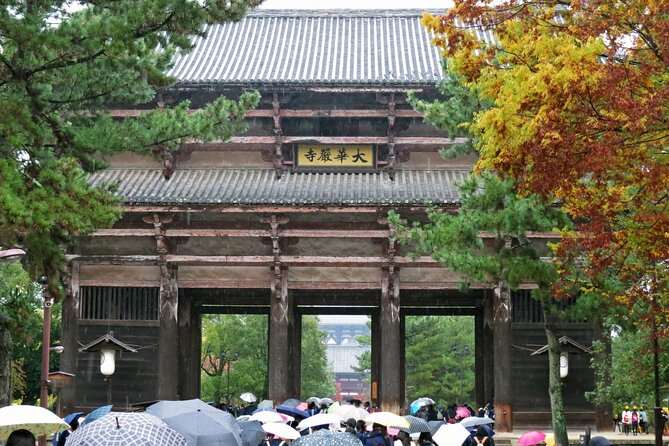
Next comes Nandaimon, Todai-ji’s Great South Gate. Rebuilt in the 13th century, this enormous wooden structure is a striking introduction to the scale and craft of the temple complex. The planned stop is brief, about ten minutes, so take a moment to look up at the gate’s imposing beams and figures before moving on.
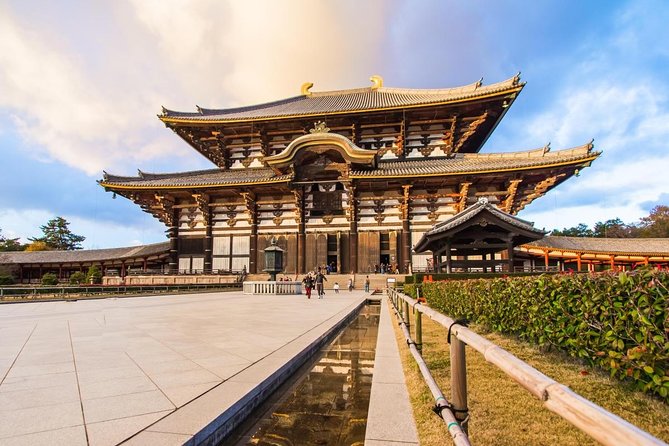
The centerpiece is Todai-ji, a UNESCO World Heritage site best known for the Great Buddha, or Daibutsu. The temple’s main hall and grounds make clear why this is one of Japan’s most celebrated religious sites. You have about an hour here, the longest stop of the tour, which gives you time to see the Buddha and take in the surrounding grounds without treating the visit as a quick photo stop.
Todai-ji has been rebuilt several times, a reminder that what you see today is part of a long history of damage, repair, and renewal. A guide can connect those changes to the structures in front of you and help you notice details that might otherwise blur together in a large complex. The quality of that explanation matters: some visitors have praised guides such as George and Kimu for making the history engaging, while one visitor felt a guide stuck too closely to a prepared script. If you want more conversation, ask questions as you go rather than waiting until the end.
More Nara trips in Nara:
- World Heritage Kyoto & Nara Uji Authentic Matcha Experience
★ 5.0 · 1,573 reviews - Kyoto/Osaka: Nara, Fushimi Inari Taisha, Arashiyama Bus Tour
★ 4.7 · 1,275 reviews - Nara Half Day Trip Walking Tour (Private Option Available)
★ 5.0 · 937 reviews
Feeding Nara’s deer, with a little care
After the temple, the route takes you into Nara Park, where around 1,200 deer roam freely. The park covers roughly 660 hectares, so a guided route can save you from spending your limited time deciding which way to go. The tour allows about 35 minutes here, including the deer-feeding experience.
One packet of deer crackers is included. That gives you a chance to feed the animals without first having to find a vendor, though it is only one packet and extra food or drinks are at your own expense. The deer are a memorable part of Nara, but they are still animals, not props. Keep your food secure and follow your guide’s directions as you approach them.
The park’s religious setting is part of what makes this encounter unusual. Here, deer are traditionally regarded as messengers of the gods, and they move among historic sites as part of everyday scenery. The mix of sacred places, green grounds, and roaming animals gives Nara a character you will not find in a temple visit alone.
Crowds can gather around the deer and at the main sights, particularly later in the day. One useful tip from past visitors is to go early if your schedule allows. The tour’s private format can help your group move more easily than a large group, but it cannot make a popular park quiet.
A quieter pause at Ukimido Pavilion
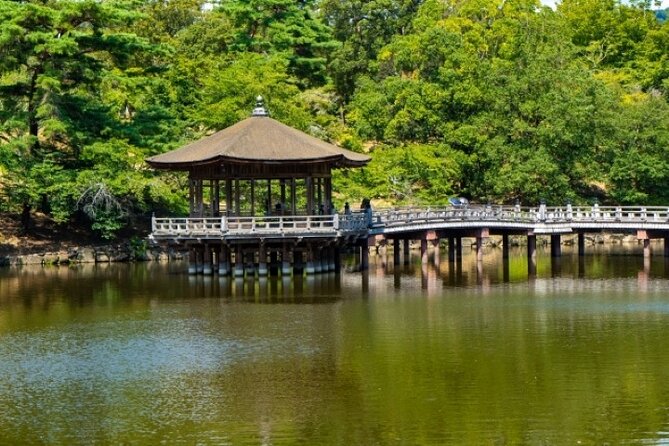
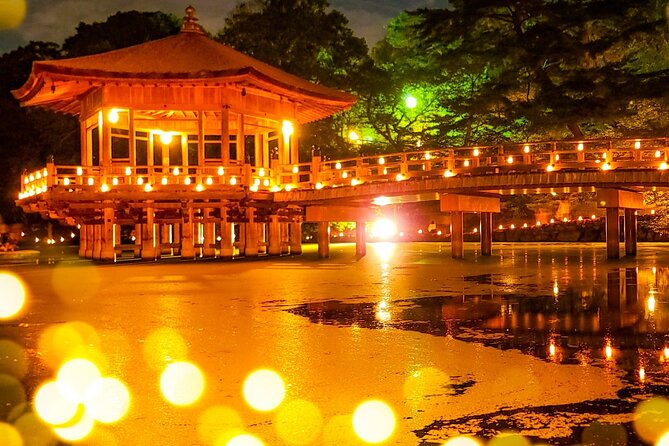
Ukimido Pavilion sits over Sagiike Pond. The small, hexagonal hall can reflect in the water on a clear day, with trees and sky around it. This is a different kind of stop from Todai-ji: less monumental, more about taking in the setting.
The tour allows about 30 minutes here. That can be a welcome pause after the larger temple and the deer park, especially if you want a moment to look around rather than keep moving from one major landmark to another. The view depends on conditions, so do not count on a perfect reflection if the weather or water surface is uncooperative.
Ukimido also gives the route a more varied rhythm. You see an immense Buddha hall, a historic gate, lively deer grounds, and then a pavilion beside a pond. For a first visit, that range helps make the half-day feel like a tour of Nara’s different moods, not just a checklist of famous buildings.
Kōfuku-ji closes the walk near the station
The final listed stop is Kōfuku-ji, with about 30 minutes set aside. The temple is known for its Five-Story Pagoda, originally built in 730 and standing about 50 meters tall. Its proportions and wooden construction make it one of Nara’s most recognizable sights.
Kōfuku-ji is a fitting end because it brings the route back toward the city and Kintetsu-Nara Station. The tour’s listed finish is near the station, but because it is private, you can arrange to disperse somewhere else that better suits your plans. Confirm your preferred finish with the guide rather than assuming the group must end at the stated point.
The time at Kōfuku-ji is enough for a focused visit, not an in-depth exploration of every part of the complex. If a particular building or detail catches your interest, ask the guide what you can reasonably see within the time available. You can also use the tour as an orientation, then return independently to anything you want to study longer.
More private and custom tours in Nara:
- Kyoto/Osaka: Kyoto and Nara Customized Private Guided Tour
★ 4.6 · 258 reviews - Nara 6hr Private Tour with Government-Licensed Guide
★ 5.0 · 219 reviews - Nara 8hr Private Tour – Kyoto DEP. with Licensed Guide
★ 5.0 · 115 reviews - Private Tour Kyoto-Nara w/Hotel Pick Up & Drop off from Kyoto
★ 4.5 · 77 reviews
What a private guide adds to a half-day
Nara’s main sights are not difficult to find, but moving between them while understanding their context takes more thought. A guide can explain why Todai-ji’s Great Buddha matters, point out the history embodied in Nandaimon, and connect the deer park to local tradition. You also avoid spending your short visit planning each next stop.
The private format is especially helpful for families or groups with different walking speeds. Families with young children have enjoyed the combination of temples, deer, and history, and one guide, George, was singled out for patience in extreme heat. That does not guarantee every child will be cheerful in summer, but the ability to stay within your own party is a real advantage.
Guide quality is the clearest variable. Several named guides, including George and Kimu or Kim, have been described as polite, attentive, and engaging. But one dissatisfied visitor found the guiding scripted and lacking in interaction. I would treat this as a reason to set expectations, not a reason to assume the tour will go either way: tell your guide whether you prefer stories, historical detail, a relaxed pace, or time for questions.
Is $96.67 per person good value?
At $96.67 per person, this is not the cheapest way to see Nara. You are paying for a private guide, a planned route, temple and shrine admissions, and the convenience of covering several major sights in roughly half a day. The deer crackers are a small extra, but a welcome one.
The value is strongest if you are visiting Nara for the first time, have limited time, or would rather not piece together the route yourself. The tour gives you an efficient introduction, and a good guide can make the stops more meaningful than a self-guided walk. If you already know the temples well or enjoy exploring at your own pace, you may prefer to visit independently and spend your money on extra time at the places that interest you most.
The tour is booked an average of 31 days ahead, so it is worth planning early if you have a fixed date. Confirmation is provided within 48 hours of booking, subject to availability. You can cancel for a full refund up to 24 hours before the start time. Poor weather may lead to a different date or a full refund.
Heat, walking, and what to bring
The tour lasts about three to four hours and is outdoors for much of that time. Japan’s summer can be very hot, with August temperatures sometimes exceeding 35 degrees Celsius. Bring water, and consider a parasol or other shade. If you are travelling with children or anyone sensitive to heat, an early start is sensible if you can arrange one.
Comfortable walking shoes are a practical choice for a route that moves between temple grounds, park paths, and a pond-side pavilion. The tour is described as suitable for most participants and is near public transportation, but the information does not specify a step-free route or detailed accessibility arrangements. If you have mobility needs, check with the operator before booking.
Food and drinks bought along the route are not included. You may want to carry water and plan for any snacks your group needs, especially in hot weather. The tour is tightly timed, so do not count on a long meal stop.
Who should book this Nara tour?
I would recommend this tour if you have a first visit to Nara and want to see the principal sights without spending half the day navigating on your own. It is also a good fit for families who like the idea of combining temples with a close look at the deer, and for anyone who values local context as much as the photographs.
It is less compelling if you want a slow, highly flexible day or a long visit inside every temple. The schedule is designed to cover several major stops in a few hours, and the guide’s style can shape how interactive the walk feels. If you book, make your interests clear at the start and ask questions as you go.
For a compact introduction to Todai-ji, Nara Park, Ukimido, and Kōfuku-ji, the private format and included admissions make the price easier to justify. If you are comfortable planning your own route and prefer to linger, you can see the same area independently. Choose the guided tour for structure, local explanation, and less route-planning, not simply for access to the deer.
FAQ
How long does the tour take?
It lasts approximately three to four hours. The listed stops total a little over three hours, with walking time between them.
Is this a private tour?
Yes. Only your group participates.
What is included in the price?
The price includes a professional guide, admission fees for the temples and shrines visited, and one packet of crackers for feeding a deer.
Are food and drinks included?
No. Extra food and drinks bought along the way are not included.
Where does the tour start?
It starts at the Todai-ji Museum, at the Todai-ji General Cultural Center in Suimonchō, Nara.
Where does the tour finish?
The stated end point is Kintetsu-Nara Station. Since this is a private tour, you can arrange to disperse at another location that suits your destination.
Can I feed the deer?
Yes. One packet of deer crackers is included for the deer-feeding experience.
Is the tour suitable in summer?
The tour runs outdoors, and August temperatures in Japan can exceed 35 degrees Celsius. Bring water and consider a parasol or other shade to help prevent heatstroke.
What happens if the weather is poor?
If poor weather causes the experience to be canceled, you will be offered another date or a full refund.
More temple and shrine tours in Nara
- Osaka/Kyoto: Arashiyama, Nara & Fushimi Inari Shrine w/Lunch
★ 4.4 · 754 reviews - E-Bike Nara Highlights – Todaiji, Knives, Deer, Shrine
★ 4.8 · 186 reviews - Nara: Great Buddha, Kasuga Shrine & Deer Park Tour
★ 4.8 · 62 reviews - Nara: Bike Tour in Ancient Capital UNESCO World Heritage
★ 5.0 · 43 reviews
Newly added in Nara
- Nara Private Day Trip – Enjoy Your First-Time Visit to Nara!★ 5.0 · 10 reviews
- Relax in Nara: Deer Park, Todai-ji Temple and Merchants’ Town★ 5.0 · 6 reviews
- Nara Todaiji Lazy Bird Walking Tour★ 5.0 · 11 reviews
- Nara: Authentic Onigiri Cooking Class & Meal in a Local Home★ 5.0 · 4 reviews
- Private Nara Tour and Sake Tasting (Departing from Kyoto/Nara)★ 5.0 · 40 reviews
- Private Journey in Nara’s Historical Wonder★ 5.0 · 3 reviews
- Nara:Private Tea Ceremony(Max 5 ppl) -Master Matcha Making-★ 5.0 · 3 reviews
- Nara Sake Tasting Tour at Local Brewerie(tasting fee included)★ 5.0 · 12 reviews
Kyoto Temple & Shrine Tours, compared.

World Heritage Kyoto & Nara Uji Authentic Matcha Experience
Read our review →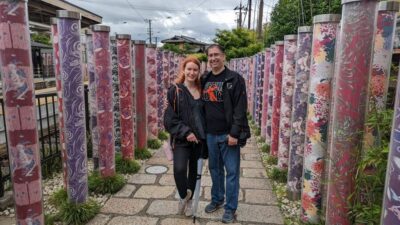
Arashiyama Bamboo, Temple, Monkeys, or Secret Sake Brewery
Read our review →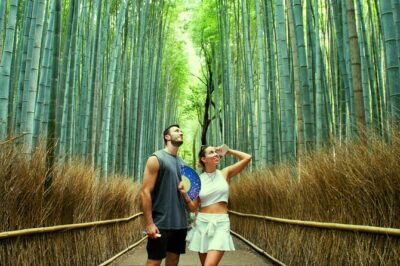
Arashiyama Bamboo Forest, Monkeys, Matcha & Temple Tour
Read our review →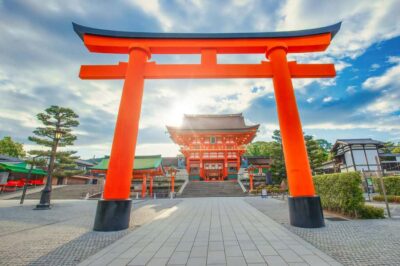
Arashiyama, Nara & Fushimi Inari Shrine w/Lunch
Read our review →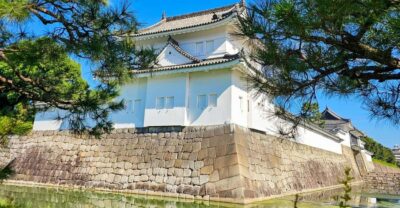
Imperial Palace & Nijo Castle Guided Walking Tour
Read our review →
Kyoto Zen Meditation & Garden Tour at a Zen Temple with Lunch
Read our review →
Browse the lists this tour appears in