
Reviewed · KYOTO CRAFT WORKSHOPS
Kyoto: Beginner Knife Sharpening & Handle Fitting Workshop
A Kyoto knife workshop gives you more than a sharp blade to pack home: you learn to work a whetstone, then fit a handle to your own knife. In two hours, you move from a short introduction to Japanese knives to hands-on sharpening and assembly. I like that the finished knife is included in the $161 price, and that the group is limited to three people, so instruction can stay personal.
I also like the practical focus. You leave with a skill you can use on knives at home, not just a souvenir for the shelf. The main consideration is that handle fitting uses fire and can make clothes smell smoky. Wear something you do not mind exposing to a bit of smoke, and arrive five minutes early.
The workshop at a glance
- Choose your blade: Pick a Santoku, Deba, or Yanagi knife for the workshop.
- Learn by doing: Practice sharpening on a whetstone with demonstrations and hands-on guidance.
- Fit a magnolia handle: Attach the included handle with help from the workshop team.
- Take home your knife: Your completed knife is packaged for you at the end.
- Keep the group small: A maximum of three participants allows room for individual corrections and questions.
- Plan for smoke: Fire is used during handle fitting, so wear clothes you can spare from smoky smells.
Start with a knife, not a souvenir shop
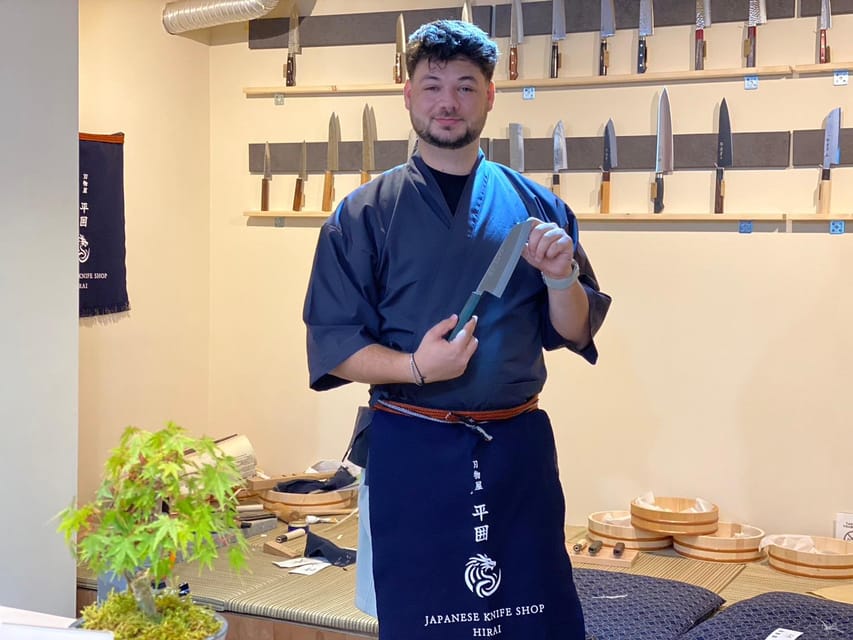
The workshop takes place at Japanese knife shop HIRAI, where you meet the team directly at the storefront. Look for the white shop curtain. The shop is in the Nishiki Market area, which can be busy and confusing to navigate, so give yourself time to find the entrance. The practical instruction is to arrive five minutes before the start, not at the last minute.
The class is capped at three participants. That small size matters in a lesson where a teacher needs to see how you hold a blade and guide it across a stone. You are not just watching a demonstration from the back of a room. You get a chance to try the technique, ask for help, and receive corrections as you work.
The instruction is available in English and Japanese. Some sessions have included English-speaking guides such as Julio or Tatsu, but instructors can vary. The useful point is that English-language teaching is available, and the class is set up for beginners rather than for people who already know their way around a whetstone.
The experience begins with an explanation of Japanese knife history. It gives context to the tools in front of you before you start handling them. The introduction is brief enough to leave time for practice, but useful if you are choosing among different blade shapes and want to understand that a Japanese knife is not simply a decorative object.
More craft workshops in Kyoto:
- Kyoto : Chopsticks Making Workshop in Gion with Engraving Option
★ 5.0 · 958 reviews - Kyoto: Calligraphy class at Buddhist temple in city center
★ 5.0 · 167 reviews - Kyoto: Small-Group Authentic Sushi Making Workshop
★ 5.0 · 137 reviews
Choose a blade that fits your kitchen
You choose one knife for the workshop from three types: Santoku, Deba, and Yanagi. These are distinct options, so it is worth thinking ahead about what you would actually use at home. The Santoku is the familiar all-purpose choice for many home cooks. Deba and Yanagi knives have more specialized uses, so consider your cooking habits before settling on one.
The workshop price is $161 per person and includes the knife you work on. That changes the value equation. You are not paying only for two hours of instruction, then facing a separate knife purchase at the end. The class combines a practical lesson with a finished Japanese knife that you can take home.
You can ask about other knives in the shop, and some participants choose upgrades. Those purchases are extra, though, and the standard choices are described as good options in their own right. There is no need to treat an upgrade as part of the class. If you are content with one of the included blades, you can focus on learning rather than shopping.
It is also worth separating the included items from optional add-ons. The magnolia handle is part of the experience fee. Other handle types cost extra, with the price depending on your choice. The shop also sells knives and whetstones, but neither an additional knife nor a whetstone is included in the workshop price. You use the shop’s whetstones during class.
Learn the feel of sharpening
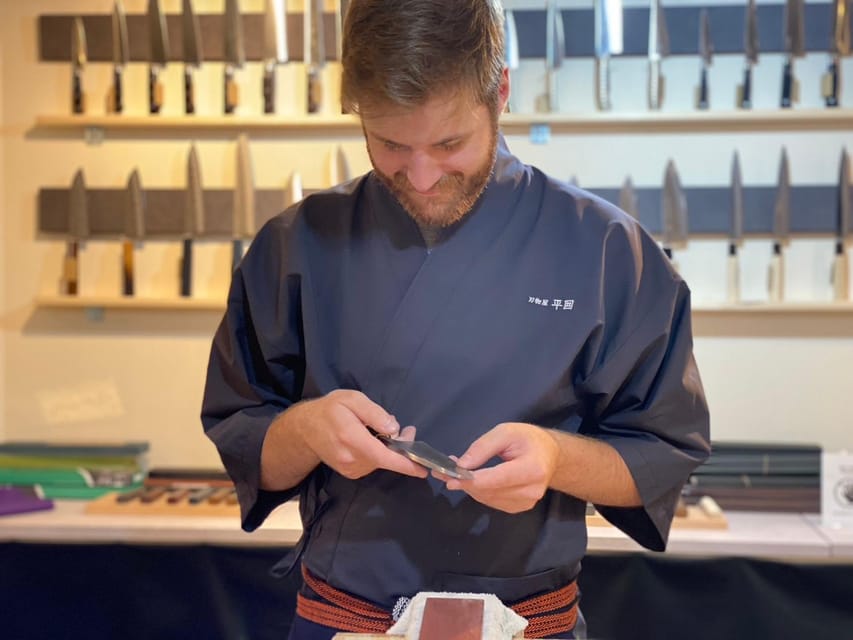
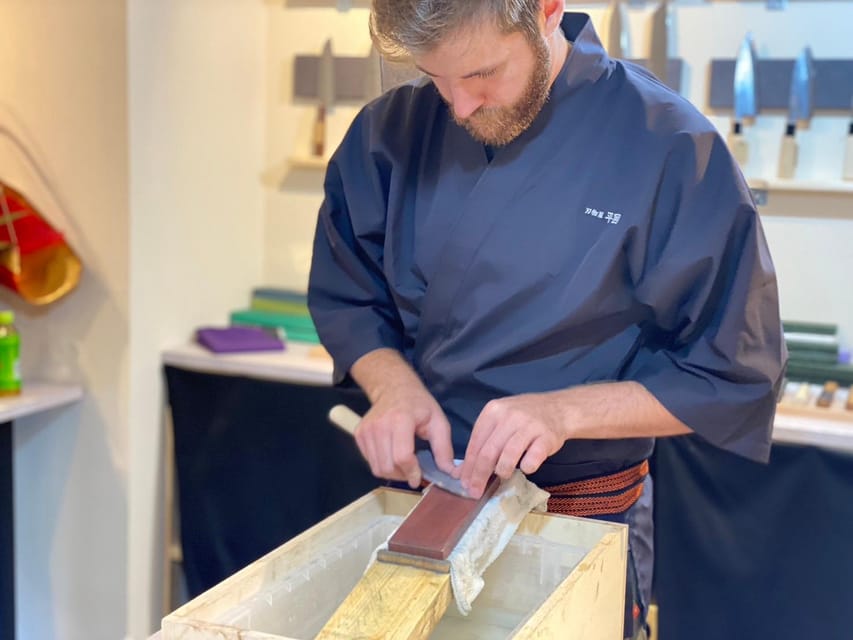
The sharpening lesson is the heart of the workshop. The instructor demonstrates the method, then you practice on a whetstone. Some sessions begin with practice on demonstration knives before participants move to their own blades. That progression gives you a chance to understand the motion before working on the knife you will take home.
For a beginner, the value is in getting feedback while your hands are on the stone. Watching a video can show you a technique, but it cannot tell you whether your angle or pressure is working. Here, an instructor can demonstrate, watch you try, and make corrections. You build a feel for the task rather than leaving with only a list of steps.
The pace calls for concentration. One participant described the class as requiring attention, which is useful to know if you expect a relaxed craft demonstration with little active work. It is approachable, but you do have to listen and practice. The reward is a much clearer sense of how to approach knife care once you are back in your own kitchen.
The lesson is beginner-friendly, not a promise that you will become an expert in a single afternoon. Two hours can give you a sound introduction and confidence to try the technique again. If you have been hesitant to use a whetstone, or have struggled to follow online instructions, this guided practice is a sensible way to get started.
A practical detail: a written guide to take home is not specified. If you want to remember the technique, pay close attention to the demonstration and ask questions while you have the instructor beside you. You may also want to make notes afterward, while the steps are fresh.
Fit the handle, with a little smoke
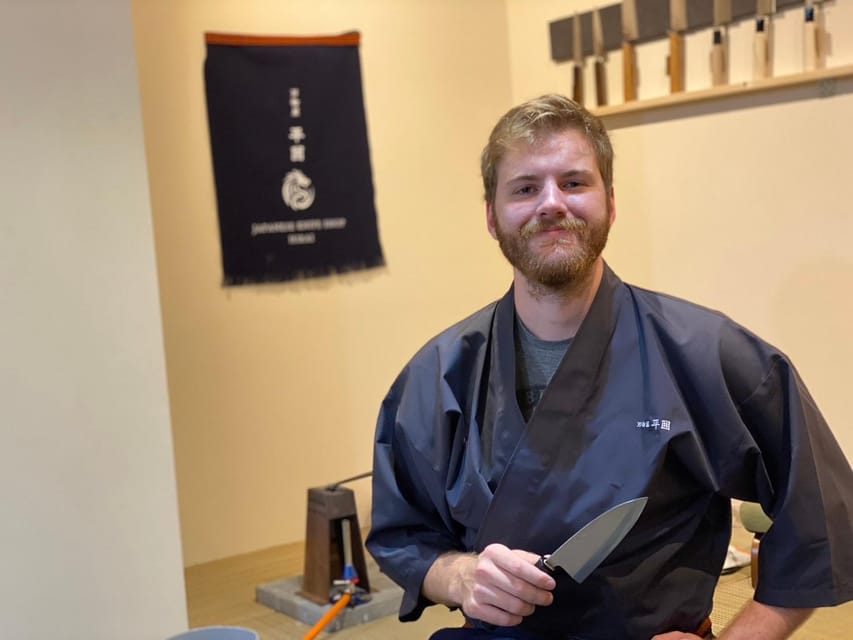
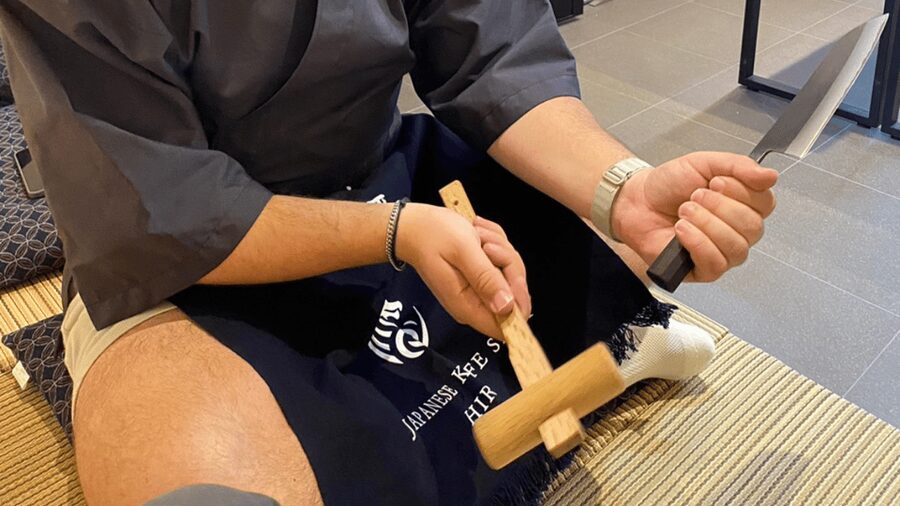
After sharpening, you move on to handle fitting. You choose the included magnolia wood handle and attach it with assistance from the workshop team. This turns the session from a sharpening class into a more complete knife-making experience. You have worked on the blade and taken part in fitting the piece you will hold while using it.
Fire is used during this stage, and smoke may come out. It is a small but important packing and clothing detail: wear something you do not mind smelling smoky. The workshop provides a Japanese working uniform and apron, but that does not change the advice about choosing clothes with smoke in mind.
You can ask about other handle styles, but those are not included in the base price. The extra charge depends on the handle you select. If you have your heart set on a particular look, ask about the cost before choosing. If not, the included magnolia handle keeps the experience straightforward and avoids turning the final stage into an unexpected shopping decision.
Once the sharpening and fitting are complete, the shop packages the knife for you to take home. That final step matters if you are carrying it through the rest of your Kyoto stay. The knife is the tangible result of the lesson, but the sharpening method is the part you can keep applying long after the trip.
More Kyoto tours in Kyoto:
- PERFECT KYOTO 1-Day Bus Tour
★ 5.0 · 13,518 reviews - Kyoto: Fushimi Inari, Kinkakuji, Bamboo Grove 1 Day Bus Tour
★ 4.8 · 4,316 reviews - Kyoto: Tea Ceremony in a Traditional Tea House in Kiyomizu
★ 4.9 · 3,519 reviews - Kyoto Geisha Walking Tour: Gion District & Hidden Gems
★ 4.7 · 3,273 reviews
Add an engraving if you plan ahead
Engraving is available, and the fee is included. You need to request it in advance and provide the characters you want, up to four letters. Do not leave this decision until you arrive if you want a personalized blade. The short limit makes it better suited to initials or a brief mark than a full name or message.
The engraving adds a personal touch, but it is optional. The knife is already tied to the experience because you sharpen it and fit its handle yourself. If you prefer a clean, simple blade, you can skip the engraving and still leave with a knife that has a story behind it.
Is $161 good value?
At $161 per person, this is not a low-cost souvenir activity. But the fee includes a knife, a magnolia handle, the workshop, the uniform and apron, and engraving if requested. You also get two hours of instruction in a small group. For someone already considering buying a Japanese kitchen knife, the included blade and practical lesson make the total easier to justify than a class fee with no finished object.
The strongest value is the combination. You are not simply buying a knife and watching someone explain it. You practice sharpening, get guidance, and take part in fitting the handle. The class also gives you a better basis for caring for the knife after you get home. That makes the purchase more useful, especially if you cook regularly.
Still, the value depends on your interests. If you only want the cheapest way to buy a knife, compare the shop’s available knives and prices before booking. The workshop is best understood as a knife purchase plus instruction and a hands-on activity, not as a bargain lesson by itself. Extra knives, alternate handles, and whetstones cost more.
The shop has additional knives for sale, but the class does not require you to buy beyond what is included. That is reassuring if you worry about being pressured into upgrades. Decide your budget before you go, and treat any add-on as a choice rather than an expected part of the session.
Who will enjoy this class most?
I would recommend this workshop to home cooks who want to maintain their own knives, anyone curious about Japanese blades, and visitors looking for a useful souvenir rather than a decorative trinket. It is especially appealing if you have been intimidated by whetstone sharpening and want someone to show you the basics in person.
It can also suit a pair or a small group of friends who enjoy learning by doing. With only three participants at most, the class is better suited to a focused session than a large, noisy group activity. The instruction is hands-on, so you should be ready to concentrate and follow directions.
It is less suitable if you are not interested in taking a knife home, want a purely hands-off demonstration, or are uncomfortable around a process that uses fire. The activity is not suitable for children under 15, wheelchair users, or people over 80. Pets, baby strollers, smoking, alcohol and drugs, and making noise are not allowed.
Practical details before you book
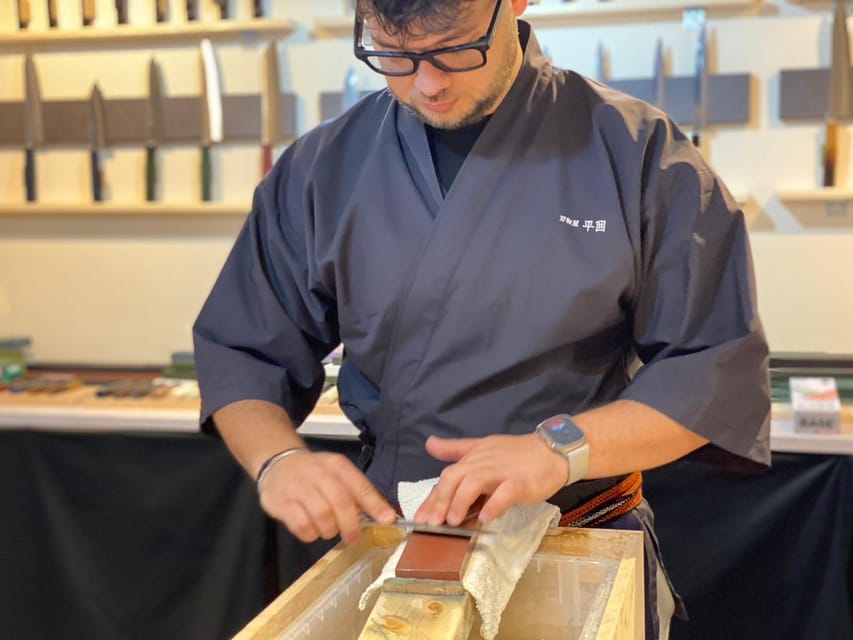
The session lasts two hours, and you meet directly at the shop. Find the white storefront curtain and arrive five minutes early to help the class start smoothly. Since the shop is in the Nishiki Market area, build in extra time to locate it rather than assuming you can spot it immediately.
Choose your knife type before the workshop, and contact the shop in advance if you want engraving. You can request up to four characters. If you want a handle other than magnolia, ask about the extra cost before making your choice.
The shop provides the sharpening stones, so you do not need to purchase one for the class. The knife and magnolia handle are included, along with a Japanese working uniform and apron. Remember the smoke advice for handle fitting, and choose your clothes accordingly.
Booking terms offer free cancellation up to 24 hours in advance, and a reserve-now, pay-later option is available. Check the available starting times when booking, since the exact schedule depends on availability.
Should you book it?
Book this workshop if you want a Japanese knife you will actually use, and you would value learning how to sharpen it rather than simply carrying it home in a box. The small group, English-language instruction, and combined sharpening and handle fitting make the two hours unusually practical for a Kyoto activity.
Skip it if the $161 price is more than you want to spend on a souvenir, if you have no use for a kitchen knife, or if the smoke and fire involved in handle fitting are a deal-breaker. For cooks and curious beginners, though, the best reason to go is simple: you leave with both a finished knife and a clearer idea of how to care for it.
FAQ
How long does the workshop last?
The workshop lasts two hours.
How much does it cost?
The listed price is $161 per person.
Which knife can I choose?
You can choose a Santoku, Deba, or Yanagi knife for the workshop.
Can I take the knife home?
Yes. The shop packages the knife after the workshop, and you can take it home.
Is the handle included?
A magnolia wood handle is included. Other handle types are available for an additional fee, which varies by handle.
Can I have the knife engraved?
Yes. Engraving is available, and the fee is included. You need to request it in advance and provide up to four characters.
Is English instruction available?
Yes. The instructors teach in English and Japanese.
What should I wear?
Wear clothes you do not mind smelling smoky. Fire is used during handle fitting, and smoke may come out.
Newly added in Kyoto
- Uji: Private immersion into Kyoto’s tea and reglious culture★ 5.0 · 17 reviews
- Whisk Your Own Matcha: A Zen Matcha Experience at Temple★ 3.6 · 7 reviews
- Kyoto tea town for matcha lovers★ 5.0 · 16 reviews
- Treasures of Kyoto: Gion & historical Walking Tour★ 5.0 · 6 reviews
- Kyoto Matcha Green Tea Tour★ 4.5 · 23 reviews
- Uji and Wazuka Matcha Farm Half Day Private Guided Tour★ 5.0 · 21 reviews
- Slow Cycling Tour at Uji’s Matcha Green Tea Fields and Heritage★ 5.0 · 25 reviews
- Uji Tea Ceremony and UNESCO Heritage Walking Tour★ 5.0 · 20 reviews
Kyoto Craft Workshops, compared.
Chopsticks Making Workshop in Gion with Engraving Option
Read our review →
Calligraphy class at Buddhist temple in city center
Read our review →
Japanese Archery Workshop with Experienced Instructor
Read our review →
Kyoto Michelin Ramen Workshop or Painting Ramen Essentials
Read our review →
Browse the lists this tour appears in